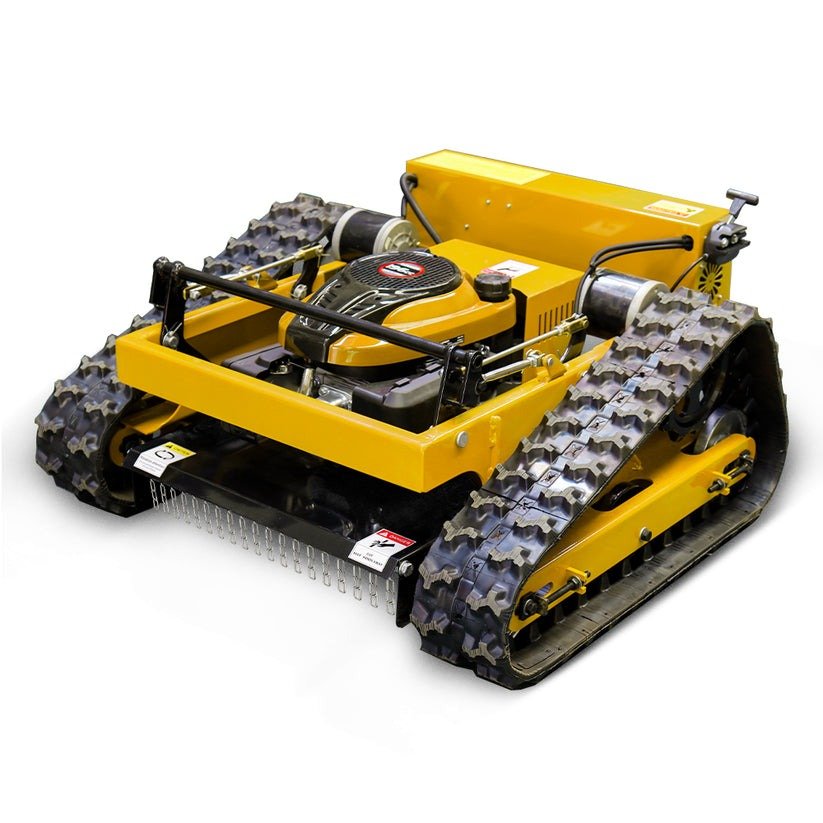
Sloped lawns, uneven terrain, and wet clay soils have quietly ended more mower engines than any dull blade ever could. Ground crews who spend their days on riverbanks, solar farms, orchards, and hillside estates have learned this the hard way. Traction fails, tires spin, and the cut turns into a scarred, patchy mess. This is exactly where a tracked lawn mower earns its keep. Instead of relying on four narrow contact patches, tracks spread machine weight across a much wider footprint, delivering grip where wheels simply give up. For landscape contractors and property managers dealing with steep gradients and soft ground, choosing the right mowing platform can decide whether a job runs on schedule or gets pushed a week. This article walks through the traction physics, the practical operating advantages, and the situations where a tracked platform outperforms conventional wheeled units.
The Traction Problem That Wheels Never Solved
Anyone who has watched a zero-turn skid sideways on a damp hillside understands the core issue. A wheeled mower places its full weight on a small contact patch, and as the slope steepens, the vector of gravity pulls the machine downhill faster than the tires can bite. Add morning dew, loose gravel, or freshly cut clippings underneath and the friction coefficient collapses. Operators compensate by cutting slower, angling awkwardly, or refusing the section altogether, which pushes labor costs up and finish quality down.
A tracked lawn mower approaches the same slope from a completely different angle. Rubber tracks distribute the machine’s mass across a footprint several times larger than any tire configuration, dropping ground pressure to a fraction of what a comparable wheeled mower produces. Lower ground pressure means the tracks stay in contact with the turf instead of tearing it, and the wide contact area resists lateral slippage. Crews routinely report holding lines on gradients in the twenty-five to thirty-degree range, territory that keeps most wheeled units parked at the curb.
Where Tracked Platforms Actually Shine
Tracked mowers are not a universal replacement, but the list of situations where they change the economics of a job is long enough to matter. Landscape contractors managing municipal parks with drainage swales, solar farm operators keeping panel rows clear, and vineyard maintenance teams working between rootstocks all share the same underlying problem: the ground is either too steep, too soft, or too fragile for a traditional deck-and-tire setup. In each of these cases, the tracked configuration converts previously manual weed-eater work into a machine operation.
Steep Embankments and Retention Ponds
Retention ponds, highway shoulders, and levees are the most obvious use case. Crews working these environments used to send two operators with walk-behind trimmers, taking half a day to finish a stretch that a slope-capable machine can now cover in an hour. The productivity math is straightforward once you factor in labor hours saved and operator fatigue reduced. Fatigue matters more than most schedulers admit, because a tired crew at the end of a hot day is where injuries and equipment damage cluster.
Wet Ground and Sensitive Turf
Golf course superintendents and sports turf managers face a different constraint. They cannot afford ruts, compaction, or turf tearing after rain. A wheeled mower rolling across saturated fairway can leave scars that take weeks to grow out. Tracks, because they float the machine on a wider footprint, let crews resume mowing sooner after rainfall without leaving a signature behind. That translates directly into billable days and better course conditions when tournaments arrive.
Orchards, Vineyards, and Row Crops
Between rows, the challenge is not just slope but also confined width and delicate root zones. A compact tracked platform maneuvers between trellises and tree bases with minimal soil disturbance. Growers particularly appreciate that the low ground pressure helps preserve the soil structure that yields depend on. Mowers designed for this segment are typically remote-controlled, which lets one operator manage the cut from a safe standing position rather than perched on a machine that might slip.
What to Verify Before You Buy
Buying decisions in this category go wrong when specifications get compared on horsepower alone. Horsepower matters, but the deck design, blade geometry, and hydraulic drive quality decide whether the machine performs day after day. A tracked chassis with a mediocre deck will still leave stripes and clumping, and a strong deck bolted to underbuilt tracks will not last a season on rocky terrain. Sourcing from a specialist supplier such as MMS INDUSTRIAL matters here because the engineering trade-offs need to be balanced across the whole machine, not just marketed on one impressive figure.
Operators should also ask hard questions about serviceability. Tracks wear, and eventually they need replacement. Availability of spare tracks, tensioning components, and drive sprockets in your region should be confirmed before purchase, not after the first breakdown. Remote-control range, battery life for the transmitter, and emergency stop behavior on slopes are further items worth testing in a live demonstration on ground that matches your actual jobsites.
Operating Practices That Extend Machine Life
Even the best-built tracked mower shortens its own life when operated carelessly. Sharp turns on hard surfaces grind tread and stress drive components. Descending slopes at full throttle overloads brake circuits. Storing the machine with tracks fully tensioned invites premature bearing wear. A short daily walk-around, a monthly grease-point service, and quarterly track tension checks handle most of what goes wrong. Keeping a maintenance log tied to hour meter readings also lets fleet managers spot developing issues before they become downtime events.
Operators new to tracked platforms should spend their first hour learning the differential steering response on flat ground before attempting a slope. The turning behavior is not intuitive if you have only run wheeled equipment, and getting comfortable in a low-stakes environment builds the muscle memory that keeps everyone safe when the terrain gets serious.
Choosing Ground Over Guesswork
The switch from wheeled to tracked mowing is rarely about horsepower or headline features. It is about matching the machine to the ground you actually work on. Slope crews, wet-turf managers, and specialty growers all face traction and compaction constraints that a tracked platform addresses at the physics level, not just through marketing claims. Investing in the right platform pays back through fewer accidents, cleaner cuts on difficult terrain, and jobs that finish on the day they were scheduled. Before committing to any specific model, run a demonstration on your steepest and softest sites, ask for serviceability documentation, and confirm that your supplier can support the machine after the sale. When those pieces are in place, the productivity gains on challenging ground make the transition worth the initial investment.