Introduction: The 400G Era and the Reach Spectrum
The networking industry has decisively entered the 400 Gigabit Ethernet era, driven by hyperscale cloud data centers, AI/ML workloads, and the insatiable demand for bandwidth. However, not all 400G links are created equal. While intra-rack connections might use SR8 or AOCs, and long-haul DCI uses coherent optics, a critical gap exists for intermediate-reach connections between 500 meters and 2 kilometers. This distance covers most data center campus interconnects, intra-metro links, and aggregation scenarios. The 400G FR4 QSFP-DD optical module was standardized to fill this vital niche efficiently and economically.
Technical Architecture: A Symphony of PAM4 and CWDM
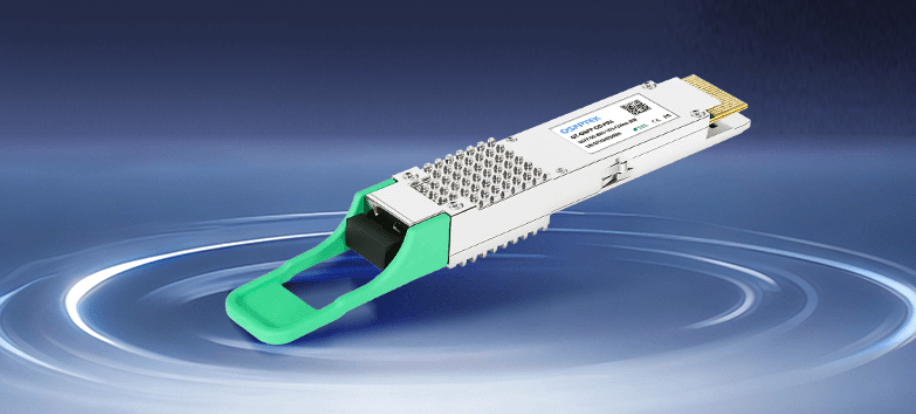
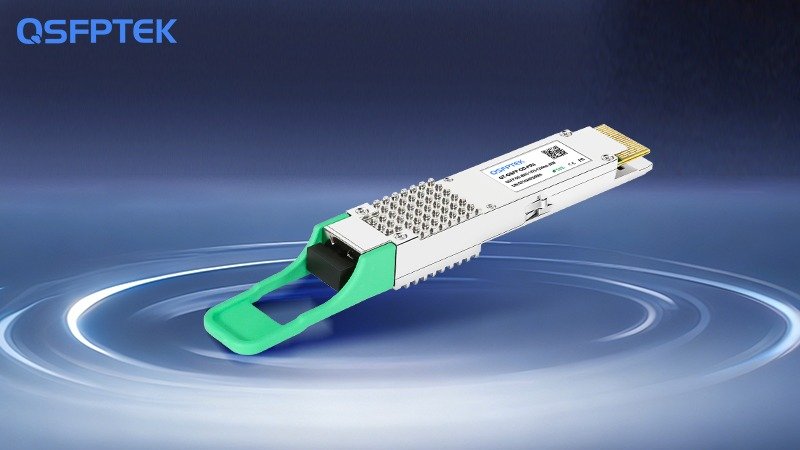
The 400G FR4 QSFP-DD represents a sophisticated integration of advanced modulation and multiplexing technologies.
- Form Factor (QSFP-DD): The Double Density (DD) form factor is critical. It maintains the familiar width of a QSFP but adds a second row of electrical contacts, providing 8 lanes at 50 Gbps each using PAM4 (Pulse Amplitude Modulation 4-level) signaling. This allows 8x50G electrical lanes to be multiplexed into 4x100G optical lanes, all within a port that is backward-compatible with QSFP28 cages, enabling high-density 400G switches.
- Optical Interface (FR4): Defined by the IEEE 802.3cu standard, “FR” stands for 4-Wavelength Duplex Fiber 2 km. It uses Coarse Wavelength-Dision Multiplexing (CWDM) with four wavelengths in the O-band (around 1271, 1291, 1311, and 1331 nm). These four 100G optical lanes (each carrying 2x50G PAM4 sub-lanes) are multiplexed onto a single pair of standard single-mode fibers (duplex LC connector). One fiber carries all four wavelengths transmit, and the other carries all four receive. This achieves 400G aggregate bandwidth over distances up to 2 km, with Forward Error Correction (FEC) being a mandatory component for reliable PAM4 operation.
Compelling Advantages Over Alternatives
- Optimal Balance of Reach and Cost: Compared to 400G LR4-10km modules, FR4 uses less complex and lower-power optics, resulting in a significantly lower cost per link for the vast majority of campus and metro DCI applications that do not require a full 10km. Compared to DR4/SR8 solutions, it provides much longer reach on standard SMF.
- High Port Density and Power Efficiency: The QSFP-DD form factor enables switch vendors to offer up to 32 or 36 ports of 400G in a 1RU chassis. FR4 modules typically consume under 12 watts, making such density thermally manageable and power-efficient compared to longer-reach coherent options.
- Leverages Ubiquitous Duplex Fiber: Unlike parallel fiber solutions (e.g., SR8/DR4 requiring 8 or 16 fibers), FR4 runs over a simple, universally deployed duplex LC fiber pair. This simplifies cabling, reduces fiber count requirements, and eases integration into existing patch panels designed for duplex connections.
Primary Deployment Applications
- Data Center Campus Interconnect (DCI): The premier application. Connecting two or more data center buildings within a campus or industrial park over distances from 300m to 2km.
- Metro and Aggregation Networks: Providing high-capacity links for service providers and telecom operators within metropolitan areas, connecting central offices or aggregation points.
- Hyperscale Data Center Spine Layer: Interconnecting spine switches or connecting leaf to super-spine layers within a large-scale data center fabric where distances exceed the reach of multimode solutions.
- Cloud Gateway and Internet Exchange (IX) Connections: Providing high-bandwidth peering and cloud on-ramp connections.
Considerations and Future Trajectory
Deploying 400G FR4 requires attention to fiber quality. Chromatic dispersion in the O-band over 2km is minimal, but link loss budgets must be carefully calculated. The use of PAM4 also means that optical signal-to-noise ratio (OSNR) and receiver sensitivity are more critical than with older NRZ signals.
Looking ahead, FR4 is a stepping stone in the 400G portfolio. It coexists with 400G DR4 (500m over parallel fiber) and LR4-10km. As technology advances, we may see FR4 optics become even more integrated and lower-power. Its true success lies in its targeted design: it doesn’t try to be a one-size-fits-all solution but excels supremely in its designated range, providing the most cost-effective and practical path to 400G for a massive segment of the market.
See also: How Digital Storytelling Turns Information into Influence
Conclusion: The Definitive Solution for Intermediate-Reach 400G
The 400G FR4 QSFP-DD module is more than just another transceiver; it is the linchpin for scalable 400G network buildouts beyond the server rack. By expertly combining the high-density QSFP-DD form factor with efficient CWDM technology over duplex fiber, it delivers the right combination of reach, density, and cost for next-generation data center interconnects and metro aggregation. As networks continue to consolidate and scale, the FR4 standard is poised to be the dominant vehicle for transporting 400G traffic over the crucial “last mile” of the campus and metro landscape, solidifying its role as a cornerstone of modern high-speed network infrastructure.