Most drivers have been tailgated at some point. A car fills your rearview mirror, the driver seems to be in a hurry and you feel your shoulders tense up. That uncomfortable gap is what traffic safety experts call an improper following distance. It’s also one of the most common reasons rear-end collisions happen, and often plays a big role when injuries and insurance claims come up afterward.
Here’s what the term means, how to tell when you are too close and why it matters after a crash.
What Counts as an Improper Following Distance
An improper following distance means driving so close to the vehicle ahead that you couldn’t stop safely if that driver suddenly hit the brakes. There’s no single number of feet that applies in every situation. The right gap depends on your speed, the road conditions, the weather and the kind of vehicle you are driving.
Most states don’t hand you a fixed measurement. Instead, traffic laws usually say a driver shouldn’t follow another vehicle more closely than is “reasonable.” That wording gives officers, insurers and the car accident lawyer a better look at the full picture. Driving 20 feet behind someone on a quiet parking lot road may be fine. Driving 20 feet behind someone on the highway at 65 miles per hour almost never is.
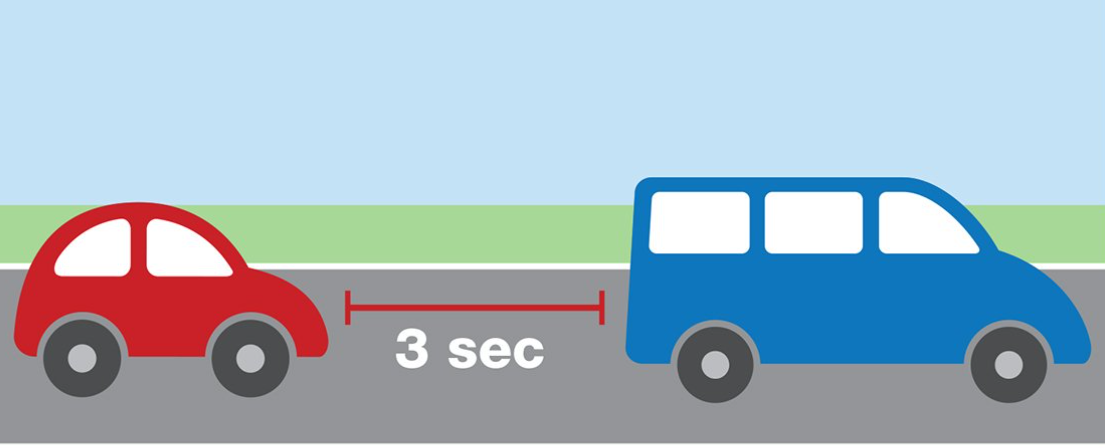
The most widely taught guideline is the three-second rule. Pick a fixed object on the road ahead, like a sign or an overpass. When the car in front of you passes it, start counting. If you reach that same spot before you get to three, you are following too closely.
Here’s how the rule changes with conditions:
- In good weather with light traffic, three seconds is the baseline.
- In rain or heavy traffic, add at least one more second.
- On snow or ice, many safety experts suggest doubling the gap or more.
- When following a large truck, motorcycle or anything that blocks your view of the road, leave extra room.
- If you are driving a heavy vehicle or towing a trailer, you need more time to stop, so you need more space.
Counting in seconds works better than counting car lengths because it adjusts for speed automatically. One car length might feel safe at 15 miles per hour. At 60 it’s a different story.
Why Tailgating Is So Dangerous
It helps to understand what actually happens when a driver has to stop in a hurry. Stopping is not instantaneous. It’s made of two parts. The first is reaction time, which is the moment it takes you to see the brake lights, process what is happening and move your foot to the pedal.
For most people that’s around 1.5 seconds. Next is braking distance, which is how far the car keeps traveling while the brakes do their work. At 60 miles per hour, you are moving about 88 feet every second.
In that 1.5 second reaction window alone, your car travels well over 100 feet before the brakes even start working. Add braking distance, and the total stopping distance can be 300 feet or more. That’s roughly the length of a football field. If the car ahead stops short and you’re only a few car lengths back, there’s simply no room left to avoid contact.
Distraction makes the problem worse. A driver who glances at a phone for two seconds while following too closely has already used up the entire safety cushion. Rear-end collisions are among the most common crash types on American roads, and following too closely is the leading cause of them. Many of these crashes happen at modest speeds, yet they still can cause whiplash, neck and back injuries, concussions and other injuries that can take months to heal.
How Following Distance Affects a Personal Injury Claim
When a rear-end crash happens, fault often lands on the driver in back. The rear driver is expected to keep enough distance to stop safely, so if they hit the car in front, it usually means they were too close, too distracted or going too fast.
That being said, it’s not automatic. The driver in front may share blame if they slammed on the brakes for no reason, had broken brake lights or cut into traffic and stopped abruptly. Many states use comparative negligence rules, which means fault can be divided between drivers, and an injured person’s compensation may be reduced by their share of the blame. A few states follow stricter rules that can block recovery entirely if the injured person was even slightly at fault, so the details depend on where the crash happened.
Evidence matters a lot in these cases. Information that can help show an improper following distance includes:
- The police report and any citation for following too closely
- Dashcam or traffic camera footage.
- Photos of the vehicles, the road and any skid marks.
- Witness statements.
- Vehicle damage patterns and data from the car’s event recorder.
Insurance companies also look closely at how the crash happened, and they may push back on who was actually responsible. Someone who has been hurt in a rear-end collision should keep medical records, repair estimates and any notes about how they felt in the days afterward, especially since those details might be important later.
The Bottom Line
An improper following distance is any gap between vehicles that’s too small for the speed and conditions. The three-second rule gives a simple way to check yourself, and adding more time in bad weather or heavy traffic always gives you a better margin. Whether you’re the one behind the wheel or the one who was hit, understanding this makes it easier to see why so many crashes happen and how responsibility gets sorted out afterward. For more information, get in touch with an experienced attorney like those at Folkman Law today.