Walk through any supermarket and you will see it everywhere: the tight, glossy wrap on a box of tea, the sealed film around a perfume carton, the crisp finish on a pack of cigarettes. That wrap is usually the work of a cellophane overwrapping machine, one of the quiet workhorses of the packaging world, and this guide explains what it does, who uses it, and how to choose the right one.
What Is a Cellophane Overwrapping Machine?
A cellophane overwrapping machine wraps a product in a sheet of clear film, folding it neatly around the item and sealing the ends. The film is usually cellophane, a transparent material made from plant fibre, although many machines also run polypropylene and other films. The finished wrap is tight, glossy and tamper-evident, so the customer can see at a glance that the pack has not been opened.
Unlike a flow wrapper, which seals products inside a continuous tube of film, a cellophane overwrapping machine folds the film around each item like a parcel. The result looks hand-wrapped, only neater and far more consistent. The machine handles rigid cartons best, because the film has something firm to fold against.
How the Wrapping Process Works
The process follows the same sequence on every cycle. The operator places a product on the infeed, and the machine draws a measured sheet of film from the roll and cuts it to size. The product is pushed into the sheet, which folds around the front, top and back of the carton. Folding plates then tuck the ends in, first on one side and then on the other, in neat triangular folds.
Heated jaws press the overlapping film together to seal the ends, and rollers smooth the wrap flat as the finished pack reaches the outfeed. The whole cycle takes seconds, and because each step happens at the same point every time, the packs look identical. Some machines add a tear strip, a thin ribbon under the film that lets the customer open the pack with one pull.
Who Uses One, and Why
A cellophane overwrapping machine is used wherever a product needs to look good and stay protected. Tea and coffee companies wrap their boxes to keep the contents fresh and show the customer the pack is sealed. Tobacco businesses wrap cigarette cartons for the same reason, and because the wrap is part of the presentation. Cosmetics makers wrap perfume and cream boxes so the pack looks premium on a crowded shelf.
Small producers use these machines too. A soap maker, a chocolatier or a small spice company may only wrap a few hundred boxes a day, but each one needs to look as polished as a product from a large brand. A cellophane overwrapping machine gives a small workshop that finish without the cost of a full packaging line, and protects the product from dust, moisture and handling marks on the way to the customer.
Manual, Semi-Automatic and Automatic Models
Machines come in three broad types. A manual machine is little more than a heated sealing table, where the operator folds the film by hand and the machine seals it. It is cheap and simple, and it suits very small runs, but the finish depends entirely on the operator.
A semi-automatic cellophane overwrapping machine does the folding and sealing itself, while the operator feeds one box at a time. This is the most common type for small and medium businesses, because it gives a consistent finish at a steady pace without a large floor area or a big budget.
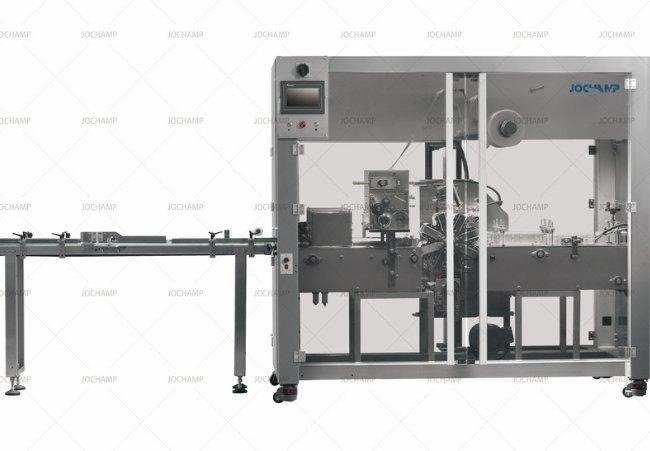
A fully automatic cellophane overwrapping machine takes boxes straight from a conveyor, wraps them without an operator, and sends them on to the next stage. It is faster, but it costs more and needs more space, so it suits larger businesses with high volumes.
5 Products That Benefit Most
- Tea and coffee boxes: the wrap keeps the contents fresh and the pack sealed.
- Cigarette cartons: the familiar tight wrap is part of the product itself.
- Perfume and cosmetics: a glossy finish makes the pack look premium.
- Sweets and biscuits: the film keeps dust out while the product stays visible.
- Gift sets and stationery: a neat wrap makes the pack feel finished and special.
What to Look for When Choosing One
Start with your product. Measure your smallest and largest boxes, and check that the machine you are considering handles the full range. A machine that only takes one size will limit you as soon as you add a new product. Then think about volume: how many boxes do you wrap on a busy day, and will the machine keep up?
Look at the film the machine accepts, and check its cost, since it is the main running cost. Ask about changeover time if you wrap several sizes, and about cleaning, because a machine that is easy to clean will be looked after. Finally, ask about support: who trains your operator, who supplies spare parts, and how quickly they answer when something goes wrong.
See also: Protecting Your South Carolina Business with Proactive IT
Frequently Asked Questions
Is cellophane the same as plastic film?
No. Cellophane is made from plant fibre and is compostable in the right conditions, while most plastic films are made from oil-based materials. Many machines run both, so check which films your model accepts.
Can a cellophane overwrapping machine wrap round products?
It wraps rigid rectangular boxes best. Round tins and irregular shapes are harder to wrap neatly and may need a different type of machine or a custom former.
How much space does a machine need?
A compact semi-automatic model fits on a bench or a small stand. A fully automatic line needs considerably more floor space, including room for the infeed and outfeed conveyors.
Final Thoughts
A cellophane overwrapping machine does a straightforward job and does it well: it takes a box, wraps it tightly in clear film, and sends it out looking neat, sealed and ready for the shelf. Whether you run a small workshop or a larger factory, the right machine is the one that matches your box sizes, your volumes and the finish you want. Get that match right, and every pack that leaves your business will make the impression you want.