The final round. Your crosshair hovers over a doorway, heart pounding, as the last enemy pushes through the smoke. Every millisecond counts — and in that split second, you wonder: is your monitor holding you back?
Curved monitors have surged in popularity across gaming setups worldwide, and it’s not hard to see why. Their sweeping screens and immersive design have turned heads at esports arenas and home battlestations alike. But beyond the aesthetic appeal, the real question competitive gamers are asking is whether a curved display actually delivers a measurable performance advantage — or whether it’s simply a premium-looking luxury.
This article cuts through the marketing noise to give you an honest, in-depth look at how curved monitors stack up for serious play. We’ll explore the immersive benefits of curved displays, break down why high refresh rates and fast response times are non-negotiable for competitive gaming, and explain how adaptive sync technology keeps your visuals fluid under pressure. We’ll also cover practical multitasking features like PIP and PBP, and walk you through a clear, step-by-step guide to choosing the right curved gaming monitor for your needs. By the end, you’ll have everything you need to make a confident, informed decision.
The Immersive Advantage of Curved Monitors for Gaming
A curved monitor works by bending the screen toward you at the edges, wrapping the image around your natural field of view. The human eye perceives the world in a roughly spherical arc, and a curved display is designed to match that curvature — meaning every point on the screen sits at a more equal distance from your eyes. The result is a viewing experience that feels more natural, less forced, and significantly more engaging than staring at a flat panel.
Beyond the “wow factor,” this design translates into real, practical benefits. Because your eyes don’t have to work as hard to refocus between the center and edges of the screen, fatigue builds more slowly during long sessions. Competitive players who grind for hours at a time will notice this difference, particularly during late-night ranked matches where eye strain can quietly chip away at reaction sharpness.
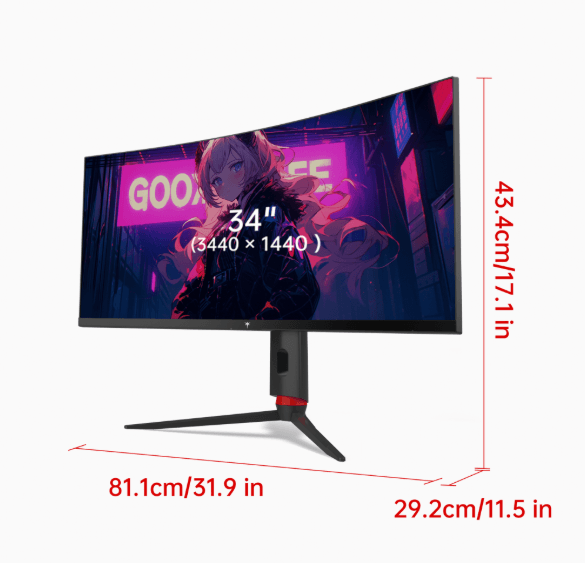
Spatial awareness is where curved monitors genuinely earn their place in a competitive setup. In first-person shooters, peripheral movement registers more naturally on a curved screen, giving you a subtle but real edge in detecting flanking enemies. Racing simulators benefit even more dramatically — the curved edges pull you into the cockpit, making corner timing feel instinctive rather than calculated. A 34-inch curved display hits a sweet spot here, offering generous screen real estate without requiring you to turn your head to track edge-to-edge action, making it a practical and popular choice for dedicated gaming stations.
High Refresh Rate and Fast Response Time: The Competitive Essentials
When milliseconds separate victory from defeat, your monitor’s technical specifications stop being numbers on a spec sheet and start becoming real performance factors. Two metrics stand above the rest for competitive gamers: refresh rate and response time. Understanding both — and demanding them in your next display — could be the most impactful hardware decision you make.
Why High Refresh Rate is a Game-Changer
Refresh rate measures how many times per second your monitor redraws the image on screen, expressed in hertz. A 144Hz display renders 144 frames every second, while a 240Hz panel pushes that to 240. The practical effect is dramatically smoother motion — enemies move fluidly rather than in choppy bursts, and your crosshair tracks targets with precision that feels almost mechanical. Beyond smoothness, higher refresh rates reduce the perceived input lag between your mouse movement and what appears on screen. At 240Hz, each frame takes roughly 4ms to display, compared to 16ms at 60Hz. That gap is small in isolation, but in a firefight where reactions are measured in the tens of milliseconds, it genuinely matters. Competitive players consistently report that stepping up from 60Hz to 144Hz feels transformative — the kind of upgrade that makes going back feel impossible.
The Role of Fast Response Time in Eliminating Blur
Response time measures how quickly a pixel transitions from one color to another, typically grey-to-grey. A 1ms response time means pixels switch almost instantaneously, leaving no smearing or ghosting trail behind fast-moving objects. Slower panels — particularly older VA monitors running at 5ms or higher — can produce visible blur behind moving characters, making it genuinely harder to track targets during rapid engagements. In a game like a battle royale or tactical shooter, that ghost image can cause you to misread an enemy’s position by a crucial margin. Pairing a fast response time with a high refresh rate creates a display that is both smooth and sharp, eliminating the two most common visual handicaps competitive gamers face. Manufacturers like KTC have built their curved gaming monitor lineup around exactly this combination, targeting players who refuse to compromise on either metric.
Adaptive Sync Technology: Smoothing Out Your Gameplay on Curved Displays
Even with a high refresh rate and fast response time, one visual problem can still sabotage your gameplay: screen tearing. This happens when your GPU outputs frames at a rate that doesn’t align with your monitor’s refresh cycle, causing the display to show parts of two different frames simultaneously. The result is a jarring horizontal split across the screen — exactly what you don’t need when tracking a moving target. Adaptive sync technology was built to solve this problem entirely.
NVIDIA G-Sync and AMD FreeSync are the two dominant adaptive sync standards, and both work on the same core principle: instead of the monitor refreshing at a fixed interval, it dynamically adjusts its refresh rate to match the frame rate your GPU is currently delivering. When your GPU outputs 87 frames per second, the monitor refreshes at 87Hz. When it climbs to 165, the monitor follows. The synchronization is seamless and continuous, eliminating tearing without introducing the input lag that traditional V-Sync solutions carry as a trade-off.
On a curved gaming monitor, this technology becomes especially valuable. The wider field of view means motion across the full screen arc is more visible — and more distracting when it tears. Adaptive sync keeps that entire curved canvas fluid and coherent, even during the frame-rate dips that intense firefights and particle-heavy explosions routinely cause. For competitive players, this translates to cleaner target tracking, fewer visual distractions, and a display that performs consistently under pressure rather than only when conditions are ideal.
See also: Modern Advancements in Metal Bending Technology
Multitasking Mastery: Utilizing PIP and PBP on Curved Monitors
Competitive gaming rarely happens in isolation. Between matches, serious players monitor coaching streams, track tournament brackets, reference build guides, or keep Discord visible without interrupting their flow. This is where Picture-in-Picture (PIP) and Picture-by-Picture (PBP) features transform a curved monitor from a single-purpose display into a genuine productivity hub.
PIP overlays a secondary input source — say, a streaming tutorial or a voice chat window from a second device — as a small, repositionable window within your main game view. You stay locked into your match while keeping peripheral information visible at a glance. PBP takes this further by splitting the screen into two equal zones, each running an independent input simultaneously. A common setup pairs a gaming PC on one half with a laptop running communications or analytics software on the other, effectively giving you two monitors in one physical footprint.
The curved screen’s wide arc makes both features significantly more practical than on a flat display. Because the edges naturally angle toward you, secondary windows placed at the periphery remain readable without requiring you to physically lean or redirect your gaze sharply. Setting up PIP typically involves navigating your monitor’s OSD menu, selecting the input source for the secondary feed, and choosing its screen position and size. For PBP, simply assign separate input sources to each half through the same menu. On a 34-inch curved display, this split feels spacious rather than cramped, keeping your workflow organized and your focus intact.
How to Choose the Right Curved Gaming Monitor: A Step-by-Step Guide
Selecting a curved gaming monitor is a significant investment, and the sheer number of options on the market makes the decision genuinely overwhelming. Breaking the process into four clear steps removes the guesswork and ensures you land on a display that actually matches how you play.
Step 1: Assess Your Priorities and Budget
Start by identifying your primary gaming use case. Esports-focused players who live in tactical shooters should prioritize speed above all else, while RPG and simulation enthusiasts benefit more from screen size and immersion. A 34-inch curved display suits most dedicated setups, offering enough real estate for immersive play without overwhelming a standard desk. Set a firm budget before browsing — knowing your ceiling prevents spec-sheet temptation from pushing you toward features you won’t meaningfully use.
Step 2: Verify Core Specifications
Treat refresh rate, response time, and adaptive sync as non-negotiable checkboxes. For competitive play, 144Hz is the minimum acceptable threshold, with 240Hz representing the current performance ceiling worth chasing. Response time should sit at 1ms or as close as possible — anything above 3ms risks introducing visible ghosting in fast engagements. Confirm adaptive sync compatibility with your GPU: G-Sync for NVIDIA cards, FreeSync for AMD. These three specifications together define whether a monitor can genuinely support competitive performance.
Step 3: Evaluate Additional Features and Ergonomics
Once core specs are confirmed, examine the supporting features. PIP and PBP functionality adds real multitasking value if you monitor streams or communications during sessions. Panel type matters too — IPS panels deliver superior color accuracy and wide viewing angles, while VA panels offer deeper contrast ratios. Check connectivity options for HDMI and DisplayPort availability, and prioritize stands with height, tilt, and swivel adjustment. A monitor you can position precisely reduces fatigue across long sessions.
Step 4: Research and Compare Models
Never purchase based on manufacturer specifications alone. Cross-reference professional reviews from hardware-focused outlets, paying close attention to real-world response time measurements rather than advertised figures, which are often tested under optimal conditions. Read user testimonials specifically from competitive players whose gaming habits mirror yours. Narrow your shortlist to two or three models — options from brands such as KTC are worth including in that comparison given their focus on gaming-oriented curved displays — then evaluate them side by side across every criterion from the previous steps. The monitor that consistently scores well across all categories — not just one standout spec — is almost always the right choice.
Is a Curved Gaming Monitor Worth It for Competitive Play?
Curved monitors bring a genuinely compelling package to competitive gaming — one that goes well beyond aesthetics. The wraparound design reduces eye strain and sharpens spatial awareness, giving you a more natural, fatigue-resistant view of the action. Pair that with a high refresh rate and 1ms response time, and you have a display that keeps up with the fastest gameplay without blur or ghosting muddying your reads. Adaptive sync ties it all together, eliminating screen tearing so your visuals stay coherent even when your GPU is working hardest. And for players who treat their setup as a full productivity station, PIP and PBP features turn a single curved display into a genuinely versatile workspace.
So, does a curved monitor enhance competitive gaming? The honest answer is yes — but with nuance. The performance gains from refresh rate, response time, and adaptive sync are real and measurable regardless of screen shape. The curved form factor amplifies those benefits through better immersion and more comfortable extended play. Whether the investment makes sense ultimately depends on your play style, desk space, and budget. If you’re a dedicated player looking to optimize every layer of your setup, a curved gaming monitor is a worthwhile upgrade. Use the step-by-step guide in this article to match the right display to your specific needs, and make the switch with confidence.