Modern manufacturing industries are experiencing a significant transformation as businesses adopt intelligent technologies to improve productivity, reduce operational costs, and maintain consistent product quality. Packaging, once considered a labor-intensive operation, has become an important area for industrial automation.
As consumer demand increases and supply chains become more competitive, manufacturers need reliable packaging systems capable of handling large production volumes without compromising accuracy. Robotic packaging solutions address these challenges by combining mechanical precision, intelligent control systems, and flexible product-handling capabilities.
From food and beverage manufacturing to household chemicals and logistics, automated packaging systems are helping businesses establish more efficient production environments. These technologies also allow manufacturers to respond to changing market demands while improving workplace safety and operational reliability.
Understanding Robotic Case Packing Technology
Robotic case packing is an automated industrial process that involves collecting, arranging, and placing finished products into cartons or shipping containers. Unlike conventional manual packaging methods, robotic systems perform repetitive operations with programmed movements and controlled precision.
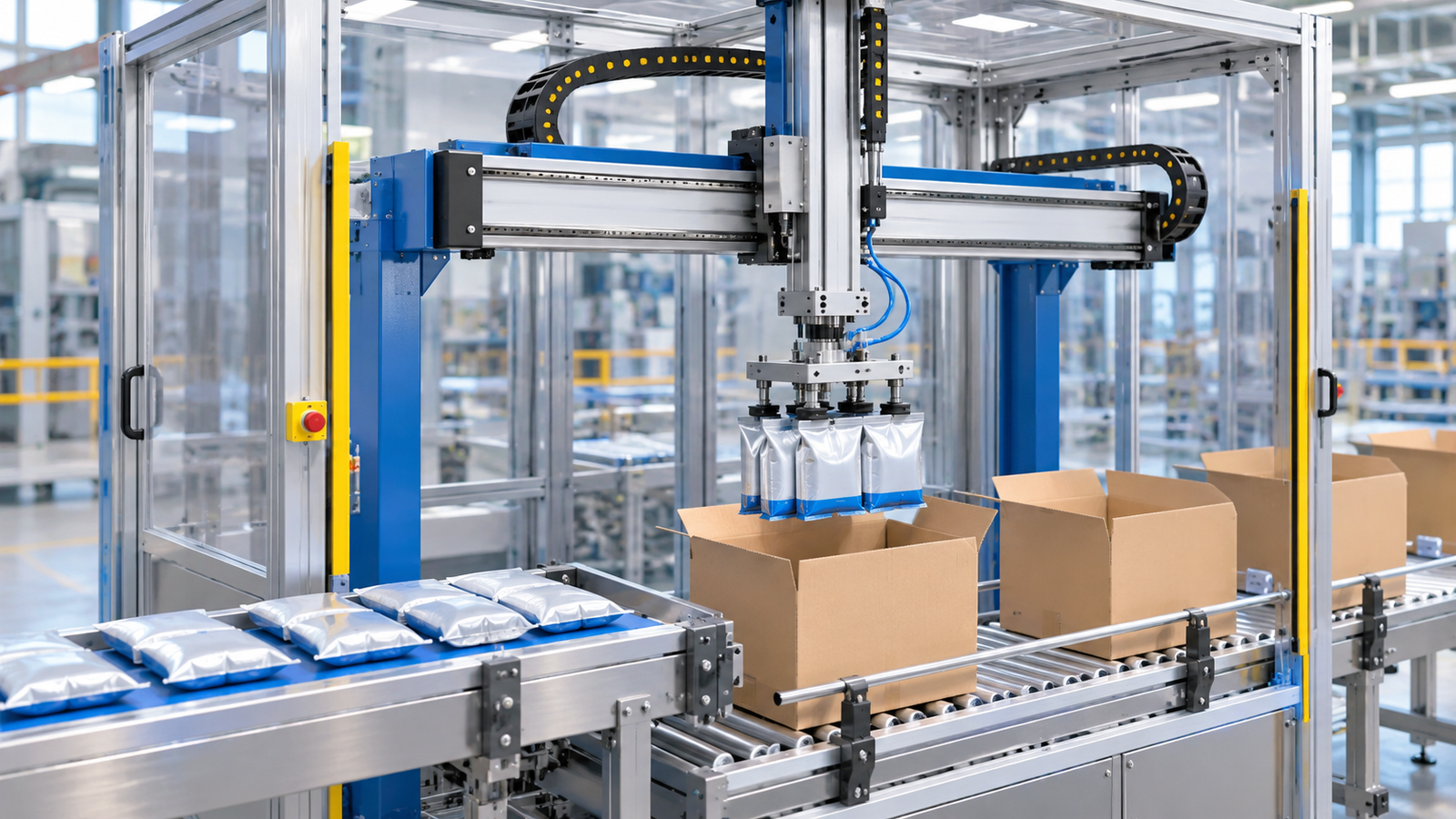
An advanced case packing robotpackaging system can help manufacturers streamline end-of-line operations while accommodating different product dimensions, packaging configurations, and production requirements.
These systems typically combine robotic mechanisms, conveyor belts, sensors, programmable controllers, and specialized gripping tools. Each component contributes to maintaining a coordinated packaging process.
Depending on the application, robotic case packers can handle bottles, pouches, bags, boxes, and other packaged consumer products. Their flexibility makes them particularly valuable for manufacturers managing multiple product categories within a single facility.
How Robotic Case Packing Systems Work
A robotic packaging system operates through a coordinated sequence of activities that ensures products are transferred into shipping containers efficiently.
Product Feeding and Detection
Products enter the packaging station through a conveyor system. Sensors detect their presence, position, and orientation. Some advanced systems also incorporate machine vision technology to identify product characteristics and detect irregularities.
Product Picking and Arrangement
The robotic mechanism uses specialized gripping tools to collect individual products or groups of products. Depending on the material and shape, these tools may include vacuum suction devices, mechanical grippers, or customized handling mechanisms.
Accurate Case Loading
The system places products into prepared cartons according to predefined packing patterns. Controlled movements help maintain consistent positioning, minimize unnecessary handling, and reduce the likelihood of product damage.
Downstream Processing
Once cartons are filled, they can be transferred to additional automated stations for sealing, labeling, inspection, and palletizing. This integrated approach creates a more coordinated end-of-line packaging operation.
The Growing Importance of Automation in Manufacturing
Industrial automation is becoming increasingly important as manufacturers seek reliable methods to improve production capacity and operational performance.
According to the International Federation of Robotics, approximately 542,000 industrial robots were installed worldwide in 2024, more than twice the number recorded a decade earlier.
This growth reflects the increasing adoption of robotics across global manufacturing industries.
Integrating an automation machine into an existing production line can help businesses minimize repetitive manual activities, improve workflow coordination, and establish more predictable production processes.
Automation also enables manufacturers to collect operational data, identify production bottlenecks, and make informed decisions regarding equipment maintenance and resource allocation.
Key Benefits of Robotic Packaging Systems
1. Increased Production Efficiency
Robotic packaging systems can perform repetitive tasks at consistent operating speeds. Unlike manual processes, which may experience variations due to fatigue or workload, automated equipment can maintain predictable performance under suitable operating conditions.
This consistency helps manufacturers achieve production targets and manage increasing order volumes more effectively.
2. Improved Packaging Accuracy
Incorrect product placement, missing items, and inconsistent packaging arrangements can create unnecessary expenses and customer dissatisfaction.
Robotic systems use programmed instructions and detection mechanisms to improve packaging accuracy. They can maintain predefined product quantities and packing patterns while reducing human error.
3. Reduced Operational Costs
Although automated packaging equipment requires an initial investment, it may provide long-term financial benefits through reduced manual handling requirements, lower product damage rates, and improved equipment utilization.
Employees can also be reassigned to quality control, maintenance, production planning, and other responsibilities requiring human judgment.
4. Enhanced Workplace Safety
Manual packaging frequently involves repetitive movements, lifting, bending, and prolonged standing. These activities can contribute to physical strain and workplace injuries.
Robotic equipment can reduce employee exposure to repetitive handling tasks. However, appropriate machine guarding, emergency-stop systems, risk assessments, and employee training remain essential for safe operation.
5. Greater Production Flexibility
Modern packaging equipment can be configured to accommodate multiple product sizes, carton dimensions, and packing arrangements.
This adaptability is particularly valuable for manufacturers that frequently introduce new products, seasonal packaging, or customized customer orders.
Industrial Applications of Robotic Case Packing
Robotic packaging technology supports a wide variety of industries, each with different operational requirements.
Food and Beverage Manufacturing
Food manufacturers use automated packaging equipment to handle snacks, cereals, confectionery, frozen products, and packaged ingredients.
Beverage manufacturers can integrate robotic systems to organize bottles, cans, and other containers into shipping cartons while maintaining consistent packing arrangements.
Equipment used in these environments must be selected according to applicable hygiene, cleaning, and food safety requirements.
Pharmaceutical and Healthcare Products
Pharmaceutical manufacturers require accurate product handling, reliable identification, and documented production processes.
Automated case packing can support these requirements by providing consistent product placement and integration with inspection and tracking systems.
Household Chemicals
Manufacturers of detergents, cleaning products, and personal care items benefit from automated handling solutions designed around different container shapes, weights, and packaging materials.
Suitable gripping mechanisms help reduce unnecessary handling and potential product damage.
Logistics and Distribution
Distribution centers use robotic packaging equipment to organize products and prepare shipments. Automated systems can improve material flow between packing stations, labeling equipment, palletizing systems, and warehouse operations.
Building Materials and Industrial Products
Heavy or unusually shaped products often require specialized packaging equipment. Customized robotic solutions can assist with material handling while reducing the physical demands associated with repetitive lifting.
The Advantages of Twin-Axis Case Packing Robots
Twin-axis robotic systems typically operate through two controlled movement axes, often horizontal and vertical. Their relatively straightforward movement structure makes them suitable for many repetitive case-loading applications.
Compared with more complex multi-axis robots, twin-axis systems may offer practical advantages when the packaging task does not require extensive product rotation or complicated movement patterns.
Potential advantages include:
- Compact equipment layouts.
- Consistent product positioning.
- Simplified movement programming.
- Efficient repetitive packing operations.
- Adaptability to suitable conveyor-based production lines.
- Potentially lower maintenance complexity.
The most appropriate robot configuration ultimately depends on product characteristics, operating speed, payload requirements, and available factory space.
How Intelligent Technology Improves Packaging Operations
Modern robotic equipment increasingly incorporates intelligent technologies that help manufacturers monitor and optimize production activities.
Machine Vision
Machine vision systems use cameras and image-processing technology to identify products, evaluate positioning, and detect selected packaging defects.
When properly configured, these systems help robotic equipment respond to variations in product placement and orientation.
Industrial Sensors
Sensors provide information about product movement, carton availability, equipment positioning, and other operating conditions.
These components help coordinate different machines and prevent packaging operations from continuing when specific requirements are not met.
Production Monitoring
Digital monitoring systems allow manufacturers to track operating performance, equipment downtime, rejected products, and production quantities.
Access to this information supports continuous improvement and helps maintenance teams identify recurring equipment problems.
Factors to Consider When Selecting Automated Packaging Equipment
Choosing the right robotic packaging solution requires careful evaluation of manufacturing requirements rather than focusing exclusively on equipment price.
Product Characteristics
Manufacturers should consider product dimensions, weight, surface materials, fragility, and handling requirements. These factors influence the selection of robotic mechanisms and gripping tools.
Production Capacity
Equipment must support current production volumes while providing sufficient flexibility for anticipated business growth. Manufacturers should evaluate actual operating performance rather than relying solely on maximum advertised speeds.
Integration Compatibility
Packaging equipment should communicate effectively with existing conveyors, carton sealing machines, labeling systems, and downstream production equipment.
Proper integration helps prevent bottlenecks and unnecessary interruptions.
Maintenance and Technical Support
Reliable technical support, accessible replacement components, operator training, and preventive maintenance programs are important considerations for long-term equipment performance.
Return on Investment
Businesses should evaluate installation expenses, energy consumption, maintenance costs, labor requirements, and expected productivity improvements before making an investment.
A realistic financial assessment helps manufacturers determine whether automation is economically appropriate for their operations.
Supporting Sustainable Manufacturing Through Automation
Sustainability has become an important consideration for modern industrial businesses. Robotic packaging equipment can contribute to environmental objectives by improving material utilization and reducing avoidable production waste.
Consistent product arrangement may help manufacturers optimize carton dimensions and reduce unnecessary protective packaging materials.
Automated inspection and controlled product handling can also reduce damaged goods that would otherwise require disposal or repackaging.
However, sustainability improvements depend on equipment design, energy efficiency, packaging material selection, and overall production management. Automation should form part of a broader environmental strategy rather than being considered an independent solution.
The Future of Robotic Packaging Technology
The future of industrial packaging will increasingly involve connected equipment, intelligent monitoring, flexible robotic systems, and data-driven production management.
Advancements in artificial intelligence, machine vision, and industrial communication technologies are expected to improve equipment adaptability and operational decision-making.
Manufacturers may also benefit from predictive maintenance solutions that identify potential equipment problems before they cause significant production interruptions.
As these technologies develop, automated packaging solutions are likely to become more accessible to small and medium-sized manufacturers seeking scalable production capabilities.
Conclusion
Robotic case packing represents an important advancement in modern industrial manufacturing. By combining precise product handling, intelligent controls, and coordinated production processes, automated packaging systems can improve efficiency, consistency, flexibility, and workplace conditions.
Businesses that carefully evaluate their production requirements and invest in suitable robotic solutions can establish more reliable manufacturing environments while preparing for future growth.
As industrial technologies continue to evolve, packaging automation will remain an important component of competitive, efficient, and sustainable manufacturing operations.