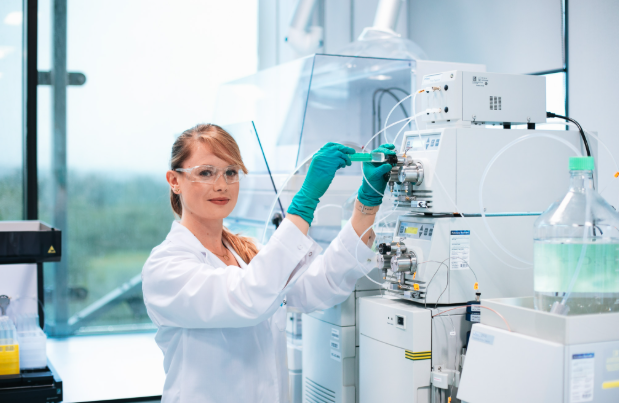
Compound purification is one of the most important steps in chemical research. Preparative supercritical fluid chromatography, or preparative SFC, has emerged as an effective technique for achieving this. In this post, we look at the preparative SFC workflow, its benefits, and post-purification applications of purified compounds.
Understanding Preparative SFC
In SFC preparative process, a supercritical fluid such as carbon dioxide is the primary solvent. This fluid exhibits characteristics of both liquids and gases, offering several key benefits. The process operates under conditions where carbon dioxide becomes a supercritical fluid, allowing it to dissolve greater amounts of diverse compounds. As a result, it enables more selective and high-throughput separations than conventional liquid chromatography.
How Preparative SFC Works
The process starts when samples are introduced into the chromatography system. The sample is mixed with supercritical carbon dioxide and a limited number of organic modifiers. Columns containing suitable stationary phases facilitate the effective separation of compounds based on their distinct characteristics. As the mixture traverses the column, different compounds are eluted at varying times, enabling their collection and subsequent purification.
Advantages of Supercritical Fluid Chromatography
There are plenty of advantages of preparative SFC over traditional purification methods. Supercritical fluids have lower viscosity and higher diffusivity than liquids, resulting in faster separations with less solvent. Because there is less waste and exposure to hazardous materials, the process is more environmentally friendly when organic solvents are used less frequently. The method is also gentler on sensitive compounds, which means that they don’t break down as much during purification.
Preparative SFC vs Traditional Approaches
Conventional liquid chromatography generally requires large amounts of organic solvent, which not only causes environmental pollution but also increases the cost of the operation. Since preparative SFC is based on carbon dioxide as a solvent, it is less harmful and can be recycled in the process. Preparative SFC stands out in workflows with large batch sizes or difficult separations, with faster run times and reduced complexity of post-purification steps.
Applications in Compound Purification
SFC is suited for preparative separation in a wide range of industries, such as pharmaceuticals, natural product isolation, and chemical synthesis. In drug discovery, preparative SFC is used for the separation and purification of chiral compounds that are important for developing safe drugs. For natural product chemists, the method is especially useful in separating complex mixtures with little material loss.
Scalability and Efficiency
Preparative SFC is flexible and can be used for both small-scale (grams) and large-scale (kilograms) purifications. Laboratories can adjust factors such as flow rate, temperature, and pressure to optimize the separation process for samples of any size. The technique’s versatility allows its use in both research and production environments, facilitating projects with different-scale purification requirements.
See also: Modern Advancements in Metal Bending Technology
Sustainability Considerations
Preparative SFC is also perfectly suited for the increasing emphasis on sustainable green chemistry. It is a better option for operations that care about the environment because it uses fewer solvents, which reduces hazardous waste. The possibility of recycling carbon dioxide contributes to a reduction in the ecological footprint, which is another advantage in creating safer laboratory environments.
Challenges and Solutions
While preparatory SFC has advantages, it also has drawbacks. Some compounds may not dissolve in supercritical fluids. Equipment assembly and maintenance will require expertise and training. Nonetheless, advancements in column technology and solvent modifiers continue to expand the range of compounds that can be purified using this technique.
Future Prospects
Preparative SFC is increasingly being accepted in both chemical research and industry. Ongoing advancements in instrumentation and methodologies will enhance efficiency and versatility. As sustainability gains importance, this is likely to encourage wider adoption of this technique for routine compound purification in laboratories.
Conclusion
Preparative SFC provides a solution to compound purification in a practical and eco-friendly manner. It is a method characterized by a combination of high speed, high efficiency, and lower solvent consumption than traditional techniques. In this context, preparative SFC is set to become a key instrument for compound purifications across a wide range of areas as research companies prioritize greener processes.