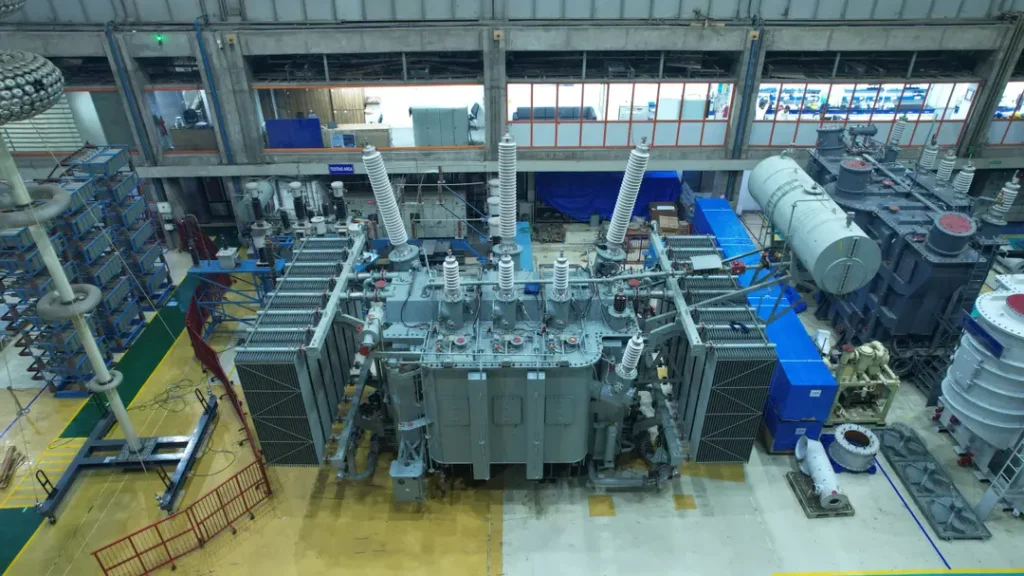
Electricity generated at power plants is not transmitted at the same voltage at which it is produced. Before it travels across long transmission lines, the voltage must be increased to reduce energy losses and improve transmission efficiency. This is where a step-up transformer plays a vital role. It is one of the most important components in modern power networks, helping utilities and industries move electricity safely and efficiently over long distances.
A step-up transformer is a type of power transformer that increases voltage from the primary winding to the secondary winding while proportionally reducing current. It operates on the principle of electromagnetic induction and is widely used in power generation, renewable energy projects, substations, and industrial facilities. As energy demand continues to grow and electrical infrastructure expands, step-up transformers remain essential for maintaining stable and efficient power transmission.
What Is a Step-Up Transformer?
A step-up transformer is an electrical device designed to increase alternating current (AC) voltage while maintaining the same frequency. It achieves this by having more turns of wire in the secondary winding than in the primary winding. When AC flows through the primary winding, it creates a magnetic field in the transformer core. This magnetic field induces a higher voltage in the secondary winding because of the increased number of turns.
Although voltage increases, the current decreases proportionally so that the overall power remains nearly constant, apart from small efficiency losses. This characteristic makes step-up transformers ideal for transmitting electricity over long distances because higher voltage and lower current significantly reduce transmission losses.
Large utility-grade step-up transformers are commonly designed as Oil-filled transformers, where insulating oil provides both electrical insulation and effective cooling. Oil-filled designs are widely preferred for high-capacity installations because they efficiently dissipate heat generated during continuous operation.
How Does a Step-Up Transformer Work?
The working principle of a step-up transformer is based on Faraday’s Law of Electromagnetic Induction. When alternating current passes through the primary winding, it creates a continuously changing magnetic field inside the laminated steel core. This varying magnetic field induces voltage in the secondary winding.
The voltage increase depends directly on the turns ratio between the primary and secondary windings. If the secondary winding has twice as many turns as the primary, the output voltage becomes approximately twice the input voltage.
Since transformers operate only with alternating current, they are not suitable for direct current (DC) applications. Their efficiency is generally very high, making them one of the most reliable electrical devices used in transmission systems.
Where Are Step-Up Transformers Used?
Step-up transformers are found wherever electrical power needs to be transmitted efficiently over long distances or supplied at higher voltages for industrial applications.
Power generation stations use generator step-up transformers to raise voltage immediately after electricity is produced. This allows electricity to travel hundreds of kilometers through transmission networks with minimal energy loss.
Renewable energy facilities, including solar and wind farms, also depend on step-up transformers. The electricity generated by renewable sources is usually produced at relatively low voltages and must be increased before it can be connected to the transmission grid.
Large manufacturing plants, mining operations, steel plants, and heavy industrial facilities often require high-voltage electrical supplies. Step-up transformers help meet these operational requirements while ensuring reliable power delivery.
High-voltage testing laboratories, research institutions, railway electrification systems, and specialized infrastructure projects also use step-up transformers for controlled voltage conversion.
What Are the Benefits of a Step-Up Transformer?
The biggest advantage of a step-up transformer is improved transmission efficiency. By increasing voltage and reducing current, electrical losses caused by conductor resistance become significantly lower. This helps utilities deliver electricity more economically across extensive transmission networks.
Another major benefit is enhanced grid reliability. Stable voltage transmission supports consistent power quality and reduces the likelihood of voltage drops over long distances.
Modern power transformer designs are also built for long operational life. With proper maintenance, they can provide dependable service for decades while maintaining high efficiency.
Many large-capacity installations use Oil-filled transformers because insulating oil performs two essential functions simultaneously. It provides electrical insulation between internal components while transferring heat away from the windings and core, helping maintain safe operating temperatures even under heavy loads.
Step-up transformers also support the growing integration of renewable energy into modern electrical grids. They enable solar parks, wind farms, and hydroelectric plants to efficiently feed generated electricity into national transmission systems.
See also: Stop Remote Work IT Headaches With a Columbus MSP
Step-Up Transformer vs Step-Down Transformer
Although both transformers operate using electromagnetic induction, their purposes are different.
A step-up transformer increases voltage while decreasing current. It is mainly installed near generating stations or renewable energy facilities before electricity enters transmission lines.
A step-down transformer performs the opposite function by reducing transmission voltage to safer levels suitable for industrial, commercial, or residential distribution. Together, these transformers form the backbone of every modern electrical power system.
Why Oil-Filled Transformers Are Common for High-Voltage Applications
Most large utility and industrial step-up transformers are designed as Oil-filled transformers because they offer excellent insulation and cooling performance. Transformer oil circulates naturally or through forced cooling systems to remove heat generated during operation.
Besides cooling, the insulating oil protects internal components from electrical breakdown and helps extend transformer life. Proper oil testing and regular maintenance are important to ensure reliable long-term performance and operational safety.
Choosing the Right Step-Up Transformer
Selecting the right transformer involves more than simply choosing the required voltage ratio. Engineers evaluate system voltage, power rating, cooling method, installation environment, efficiency requirements, load characteristics, and applicable national or international standards.
Manufacturers also customize transformer designs for utilities, renewable energy projects, industrial plants, and infrastructure applications based on project-specific requirements. Advanced manufacturing, rigorous testing, and quality control help ensure reliable performance under demanding operating conditions. Companies such as Transformers & Rectifiers (India) Ltd. (TARIL) manufacture high-voltage transformer solutions for domestic and international power infrastructure projects, including power transformers up to 1200 kV and 1000 MVA.
Conclusion
Step-up transformers are fundamental to efficient electrical power transmission. By increasing voltage before electricity enters long-distance transmission lines, they minimize energy losses, improve overall grid efficiency, and support reliable power delivery to industries, cities, and communities. Whether installed in conventional power plants, renewable energy facilities, or large industrial operations, these transformers continue to play a central role in modern electrical infrastructure. Combined with durable Oil-filled transformers technology and advanced power transformer engineering, they provide the performance, reliability, and efficiency required for today’s expanding energy networks.
Frequently Asked Questions
What is the main purpose of a step-up transformer?
A step-up transformer increases AC voltage while reducing current, making long-distance power transmission more efficient by minimizing transmission losses.
Why are oil-filled transformers commonly used for step-up applications?
Oil-filled transformers provide excellent electrical insulation and efficient cooling, making them suitable for high-voltage and high-capacity applications that require continuous operation.
Where are step-up transformers commonly installed?
They are typically installed at power generation stations, renewable energy plants, industrial facilities, substations, and infrastructure projects where voltage needs to be increased before transmission.
Does a step-up transformer increase electrical power?
No. A step-up transformer increases voltage while reducing current. The overall power remains nearly the same, except for small efficiency losses during operation.
Is a step-up transformer a type of power transformer?
Yes. Large utility and transmission-grade step-up transformers are classified as power transformers because they are designed for high-voltage electricity transmission between generation and distribution networks.