Purchasing several indoor plants at once is quite an easy way to bring more greenery into your home. The trick is in creating an indoor collection out of them and not just a bunch of unrelated pots. A cohesive collection needs both visual cohesion and compatibility in the conditions for the growth of the plants.
To create a bundle of indoor plants, start by considering the room they will inhabit. There is a significant difference in the conditions that Houseplants may need, like the amount of light, humidity, temperature, and watering. That is why you should plan your bundle taking into account the conditions you can offer to the plants at home. According to the Royal Horticultural Society, choosing and arranging indoor plants should be done based on their growing requirements and not only for decoration purposes.
Start With the Room, Not the Plant
First of all, analyze where the plants will be located inside a house. Check how much light reaches this place and whether it is changing during the day. Other factors like nearby radiators, draughts, and rooms with higher humidity should be considered as well.
Lighting is especially important. Some plants can thrive in bright but indirect light while others may tolerate low-light environments. According to the RHS, the needs of each plant can be quite different, and it is better to learn about every plant before choosing its location.
Choose Plants With Similar Care Needs
A collection is much easier to take care of when its plants have similar needs. They don’t have to be identical, but the selection of plants that grow well in a similar environment makes maintenance easier.
For example, a bundle might focus on plants that prefer:
- Bright, indirect light
- Moderate watering
- Consistent humidity
- Similar indoor temperatures
This approach will reduce the temptation to water all plants according to the same schedule. Plants of different species may need to be watered at different intervals, even though they reside in the same room.
Create Contrast With Height and Leaf Shape
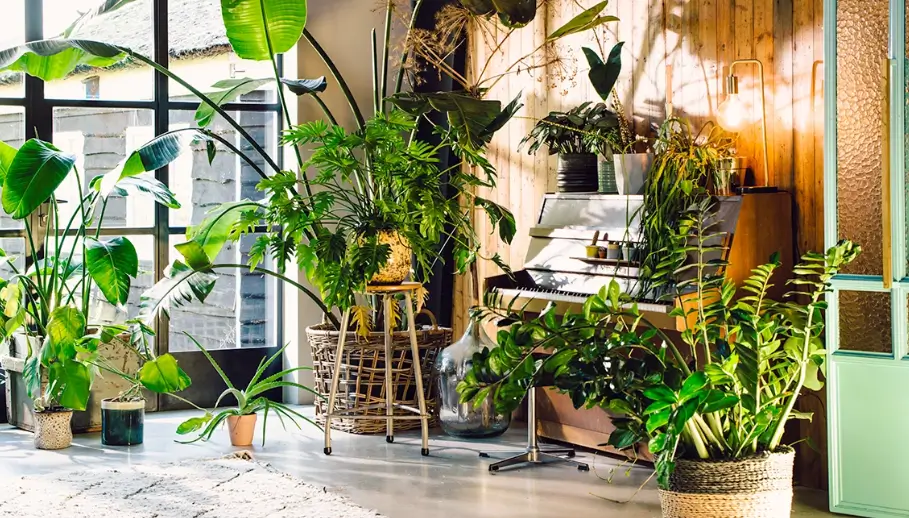
Once you’ve considered the growing conditions, start thinking about how your plant collection would look altogether. The difference in height of plants creates depth and prevents a display from looking flat.
A simple arrangement can include:
- One taller plant as a visual anchor
- Medium plants to fill the middle level
- A trailing plant to soften the edges
Another option for creating a contrast would be to use variations in leaf shape. For example, broad leaves can complement narrow, erect foliage, and small leaves can highlight a bigger statement plant. However, the goal here is not to make all the plants match, but rather to provide each with a certain role.
Use Colour and Texture to Tie the Collection Together
Plants naturally offer plenty of variation through foliage colour, markings and texture. A collection can feel more intentional when one or two of these features repeat across the display.
For example, a variety of plants with various leaf shapes can coexist provided they have close green coloring. Alternatively, variegation in leaves will make a difference against the background of solid leaves.
The same principle applies to containers. Repeating a pot finish or colour can visually connect plants without requiring identical species.
Group Plants Without Creating a Care Problem
Grouping plants in pots is likely to have an effect on their visual appearance and humidity. RHS mentions that grouping can be beneficial since moisture from the leaves can increase humidity around them.
However, grouping does not mean that plants should be placed in exactly the same conditions. A humid-loving tropical plant and another plant that needs dry air have to have different positions. Make sure there is enough space to check the leaves, rotate the pots, and look after each plant separately.
See also: What Homeowners Should Expect During a Major Home Cleanout
Choose Pots and Placement as Part of the Bundle
Pots are part of the overall composition, but plant health comes first. Containers should provide suitable drainage, and decorative outer pots should not leave plants sitting in excess water.
Different heights of pots or using stands for plants can be helpful to create varying heights of plants. There should be enough open spaces between larger plants to avoid visual overcrowding of the whole composition.
It might be helpful to arrange taller plants in the background, medium-size plants in the center, and hanging plants where they can hang down freely.
Build a Simple Care Routine
An integral composition is much easier to take care of if it involves a feasible maintenance schedule. It is better not to water all Houseplants on the same day, and just check the growing medium first.
As advised by the RHS, it is better to take into account soil moisture and not only adhere to the calendar. Moreover, containers should have drainage holes so that excess water can escape.
Keep a simple routine for checking:
- Soil moisture
- Leaf condition
- Light exposure
- New growth
- Signs of pests or stress
A successful indoor plant bundle does not require identical plants. The strongest collections combine compatible growing conditions with thoughtful differences in height, foliage, texture, and placement. Start with what the room can provide, then build the visual style around it.