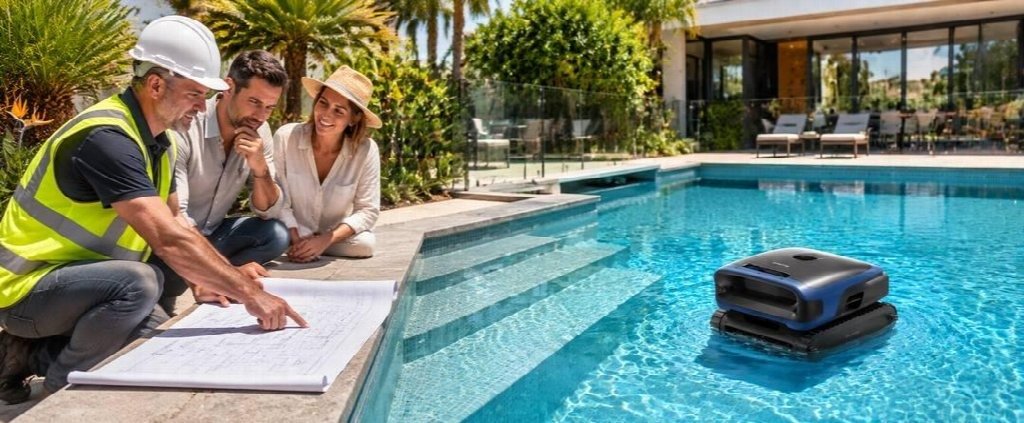
A residential pool can look flawless on a drawing and still be difficult to clean once the owners move in. Narrow steps, curved walls, equipment access and poorly planned planting may add years of work. For builders and designers, maintainability deserves attention before the shell is completed and the paving is laid. It affects how filters are serviced, whether cleaning equipment can reach the water and which surfaces will need manual attention. A better design does not eliminate pool care. It gives owners and service teams straightforward access to the tasks they will need to perform throughout the pool’s life.
Make maintenance part of the early design brief
The discussion should begin with the client’s intended use. A compact plunge pool, a family swimming pool and a landscaped showpiece have different patterns of debris and use. Ask how frequently the property is occupied, who will maintain the water, what planting surrounds the pool and which surfaces the owner expects to keep pristine.
Document the expected maintenance approach along with the pool dimensions and finish specifications. If the owner wants robotic pool cleaner equipment for floor and wall cleaning, check access, minimum depths and likely obstacles before finalising steps and benches. If a service contractor will carry out most work, review the room available around equipment and the route used to transport tools.
Avoid promising that a design will be “maintenance-free”. Pumps, filters, water-treatment systems and safety barriers all require inspection. The realistic objective is to reduce awkward manual cleaning and make necessary servicing easier and safer.
Pool geometry can create permanent cleaning blind spots
Steps and sun shelves
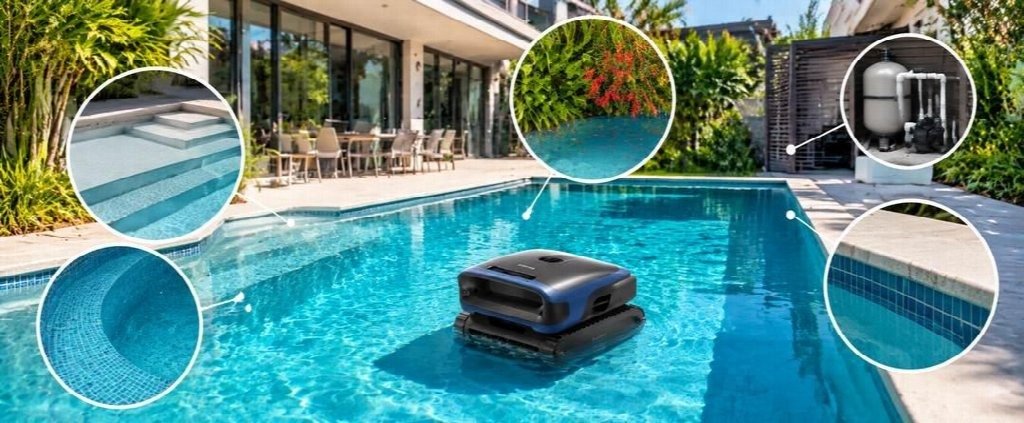
Broad submerged platforms suit social use but can trap grit. Robot compatibility depends on more than the presence of a flat surface: minimum depth, usable width and turning space matter. Narrow individual treads may fall outside a cleaner’s operating limits even if the larger shelf can be cleaned.
Published specifications, including examples in Beatbot’s Australian collection, can help a designer establish the intended cleaning method before fixing dimensions. Where mechanical cleaning is not supported, include a practical manual-access route. A step that is difficult to reach with a brush will remain difficult long after construction is complete.
Curves, slopes and vertical transitions
A curved floor-to-wall transition can affect a robot’s traction and change the way debris moves. Strong suction does not compensate for poor contact or a route that repeatedly ignores an area. Ask equipment suppliers about compatibility with the proposed finish and geometry, and avoid treating an animated route drawing as performance evidence.
Ladders, handrails and fittings
Ladders and protruding fixtures can interrupt a cleaner’s movement. Consider whether the fittings can be accessed for inspection and whether the adjacent floor can be cleaned. Fixtures must still meet applicable design and safety requirements; ease of robot navigation is not a reason to compromise these.
Choose finishes with cleaning methods in mind
Pool finishes have different requirements for brushing, chemical care and equipment contact. Tile, plaster, fibreglass and vinyl should not automatically receive the same treatment. Consult the finish supplier on compatible brushes and cleaners, particularly where the surface carries a warranty.
Waterline detailing deserves attention. Residue from oils, sunscreen and airborne particles can form a visible band. A finish with intricate edges or very narrow decorative recesses may demand more manual care than a simple continuous band. Designers should discuss this trade-off when choosing details with the client.
The surrounding coping and deck influence the pool as well. Loose particles from landscaping, drainage that washes soil into the water, and slippery paving can add ongoing work or hazards. Address these during the construction and landscape coordination phase rather than leaving them for the owner to solve.
Plan the plantings and drainage together
Trees provide shade and privacy but may drop leaves, flowers and seed pods into the pool. The problem is not simply how many trees are planted; wind direction, canopy position and skimmer placement also matter. Observe the site and speak with the landscape team about likely seasonal conditions.
A drainage detail should direct runoff appropriately without carrying soil and mulch into the pool. Heavy rain may still affect water chemistry, but good grading and surface management can reduce unnecessary debris. The precise drainage design must follow local requirements and professional engineering advice.
Consider maintenance access to garden beds and surrounding edges. If pruning or sweeping requires workers to cross a fragile coping detail or work around an inaccessible corner, the attractive detail may carry an avoidable long-term cost.
Leave room for equipment servicing
Pool pumps, filters, heaters, chlorinators and control systems need adequate access and ventilation according to their installation manuals. A small concealed cabinet may look tidy but make filter servicing or component replacement difficult. Plan drainage, electrical safety and clearances early with the relevant trades.
Where a robotic pool cleaner is part of the intended setup, consider a safe storage and charging location. Cordless equipment needs a dry, suitable charging area and a route that allows the wet unit to be carried without dripping across sensitive interiors. Corded systems need appropriate power placement and cable handling.
Product dimensions and operating limits should be checked against the built pool rather than assumed from a category name. A homeowner may later choose a different model, so the design should favour practical access rather than depend entirely on one device.
Match the cleaning specification to the client’s pool
A robot can automate supported floor and wall cleaning, but its capabilities should be written in clear terms. Some machines add deliberate waterline cleaning, suitable shallow-platform operation or active collection of floating debris. These are separate functions and may require particular modes or minimum dimensions.
For a client evaluating robotic pool cleaner equipment, useful documentation includes supported surfaces, minimum water depth, maximum pool size, type of debris filter and end-of-cycle retrieval. Selecting based only on the machine’s advertised suction rate can overlook the areas that create the greatest manual workload.
Beatbot’s Australian collection includes models with differing cleaning zones. A design professional can use such specifications to check whether a proposed sun shelf or bench falls within the stated requirements, but should confirm the exact model data before making a recommendation. Manufacturer performance claims are not equivalent to independent tests.
A handover checklist for the owner
1. Provide final pool dimensions, depth and finish information.
2. Identify the location and operating instructions for pumps, filters and treatment equipment.
3. Record which cleaning methods and brushes are compatible with the finish.
4. Highlight steps, ledges and corners that require manual attention.
5. Demonstrate filter cleaning, equipment isolation and safe storage practices.
6. Supply written safety-barrier documentation and the applicable inspection information.
7. Identify the water-testing, disinfection and professional service responsibilities.
8. Leave a register for maintenance dates, equipment faults and replacement parts.
These details protect the owner’s ability to maintain the design. A beautiful pool with undocumented equipment and unclear service access can become unnecessarily difficult to operate.
Avoid confusion between cleaning and water treatment
A cleaner’s filter collects physical debris. It does not maintain disinfectant levels, pH or circulation. The main treatment and filtration system must be properly designed and maintained. Green or cloudy water requires diagnosis and appropriate intervention, not just more vacuuming.
Designers and builders should also distinguish public and private pool rules. Shared pools in apartment projects may have different operational, accessibility and health requirements from a residential backyard. An informal domestic checklist cannot replace the relevant code or professional guidance for a commercial or shared setting.
Pool safety barriers, child supervision and compliant electrical work are separate responsibilities. Cleaning automation should never be used to justify changes that weaken required protections.
Design decisions that help after storms
Weather can expose the weak points in a pool layout. Leaf fall, sediment runoff and blocked baskets are common issues after wind or rain. Access to skimmers and other debris-collection points should be straightforward, allowing a service person to remove material without awkward lifting or unsafe reaching.
Keep potentially hazardous branches or objects out of the robot’s path. A machine intended for ordinary leaves and fine debris is not a substitute for manual removal of sharp or oversized material. After heavy rainfall, water testing remains important because cleaning equipment does not restore chemical balance.
A resilient design makes recovery work predictable. Equipment access, suitable drainage and an owner’s understanding of operating limits can be more valuable than another control screen.
See also: Modern Advancements in Metal Bending Technology
Frequently Asked Questions
Should a pool be designed around one robotic cleaner?
Usually not. Check compatibility with the intended equipment, but leave practical manual access and flexibility for future models. Cleaning requirements and equipment designs may change over time.
Can pool robots clean all steps?
No. Many have minimum depth and platform-size requirements. Narrow steps may need manual attention regardless of the cleaner used.
Do different pool finishes require different cleaning tools?
Yes. Finish suppliers can specify compatible brushes and maintenance procedures. A cleaner suitable for one finish should not automatically be used on another.
How much space should a pool equipment area have?
Follow the specific equipment manufacturer’s access, ventilation and service clearances, along with applicable building and electrical requirements. There is no universal dimension suitable for every installation.
Does robotic cleaning replace filtration and water testing?
No. A robot handles selected physical cleaning tasks; circulation, disinfection, filtration and safety remain essential.
Maintainability belongs in the design
Low-maintenance pool design is achieved through practical decisions made before construction: accessible equipment, suitable finishes, sensible drainage, cleanable geometry and a realistic operating plan. These details will affect the owner long after the initial photographs are taken. The strongest handover makes it clear what equipment can do, where manual work remains and who is responsible for keeping the water safe.