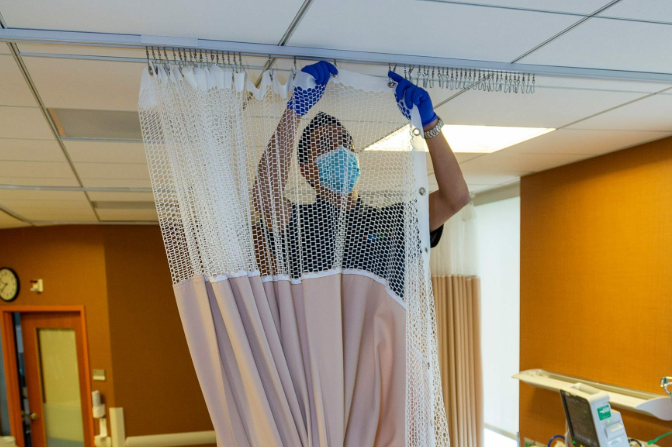
The use of Disposable Curtains in hospitals provides convenience. But a question also arises. What happens to these curtains after use?
Since they are replaced instead of reused, waste generation is a natural consequence. For this reason, the impact on the environment should not be ignored.
But it is not correct to simply say that every disposable curtain is necessarily bad for the environment. The real difference lies in the use, quantity, and disposal method.
Where Does the Environmental Concern Come From?
The main problem starts with waste. A washable curtain can be used many times. In contrast, a disposable curtain is replaced after its life span is over. If many curtains are changed daily in a large hospital, the amount of waste can also increase. This is why hospitals should monitor their monthly consumption.
Frequent Replacement Means More Waste
Frequent replacement has its benefits, but it also has a downside. The more curtains that are removed after use, the more material is wasted. This number can be quite high, especially in busy wards.
Therefore, it is better to replace only when necessary. Replacing curtains without reason increases both usage and waste.
What Happens After Use?
Where and how to dispose of used curtains is also important. Not all types of waste generated in a hospital are suitable for one method. Some used items may need to be handled according to specific instructions.
Therefore, the institution should check its waste management policy before throwing curtains in the general waste.
Can Hospitals Reduce Curtain Waste?
Yes, waste can be reduced with a few simple steps. Avoid unnecessary replacement in the first place. If the curtain is still usable and the hospital policy allows it, it does not need to be replaced before the specified time.
Secondly, keep a record of the consumption of different wards. This can show where an unusual amount of curtains are being used.
Choosing Products Carefully
When purchasing, do not look only at the price or appearance. The expected lifespan of the curtain, the purpose of use and information on disposal can also be seen.
If information about the material or disposal requirements is available from the supplier, it is better to understand them first. In this way, the purchasing decision can be made more thoughtfully.
Reusable Curtains Still Have Their Place
Reusable curtains should not be overlooked when thinking about the environment. Where a proper cleaning system is in place, a reusable curtain can be used many times. This can reduce the need to dispose of a new curtain after each use.
But that doesn’t mean that reusable options are the best option everywhere. Hospital cleanliness, patient numbers and your infection control requirements also need to be considered.
A More Balanced Approach
There is no one-size-fits-all solution when it comes to the environment. Disposable curtains may be more practical in one ward. Reusable curtains may work better in another.
The real goal should be to ensure that what is used is actually used as needed. Fewer unnecessary changes can also mean less unnecessary waste.
Conclusion
Disposable Curtains can have an impact on the environment, especially when they are used in large quantities and not properly managed after use.
But the problem is not just the type of curtain. The frequency of change, the amount of use and waste management are also important. Hospitals can manage waste better if they keep records of their consumption, avoid unnecessary changes and adopt appropriate disposal practices.
Frequently Asked Questions
1. Do disposable curtains create more waste than reusable ones?
Disposable curtains are usually thrown away after a period of time, while reusable curtains can be reused after cleaning. That is why the amount of waste between the two can vary. The real difference also depends on how often the curtains are changed.
2. Can hospitals reduce the amount of curtain waste?
Absolutely. First of all, unnecessary changes can be reduced. If each ward keeps a record of its usage, the areas with high consumption can be easily identified. Then both the order and the usage can be managed better.
3. Are reusable curtains always better for the environment?
The answer is not necessarily the same everywhere. Reusable curtains can be reused, but their cleaning also requires water, energy and other resources. Therefore, it is more appropriate to see the whole picture.
4. What should hospitals do with used disposable curtains?
When handling used curtains, the hospital should keep its own waste management policy in mind. If there is a separate disposal procedure for a specific area, it is best to follow that.
5. How can a hospital make its curtain use more sustainable?
A good start is to understand current usage. It is helpful to review how often curtains are being changed, where they are being used the most, and where unnecessary changes may occur. The institution can then choose the best method according to its needs can prepare.