| On This Page 1. The Problem: Why the Framework Choice Makes or Breaks a Travel App 2. React Native vs Flutter: The Core Difference 3. Performance Compared for Travel Apps 4. Maps Compared: Location, Routes, and Offline Tiles 5. Offline Capability Compared: Booking and Itineraries Without Signal 6. The Verdict: Which to Choose for a Travel App 7. Implementation, Technical Approach, and Mobile Best Practices 8. Cost, Timeline, and Tech Stack 9. Real Case Study: Good2Know Real-World Performance 10. FAQs (Short Answers) and Related Reading |
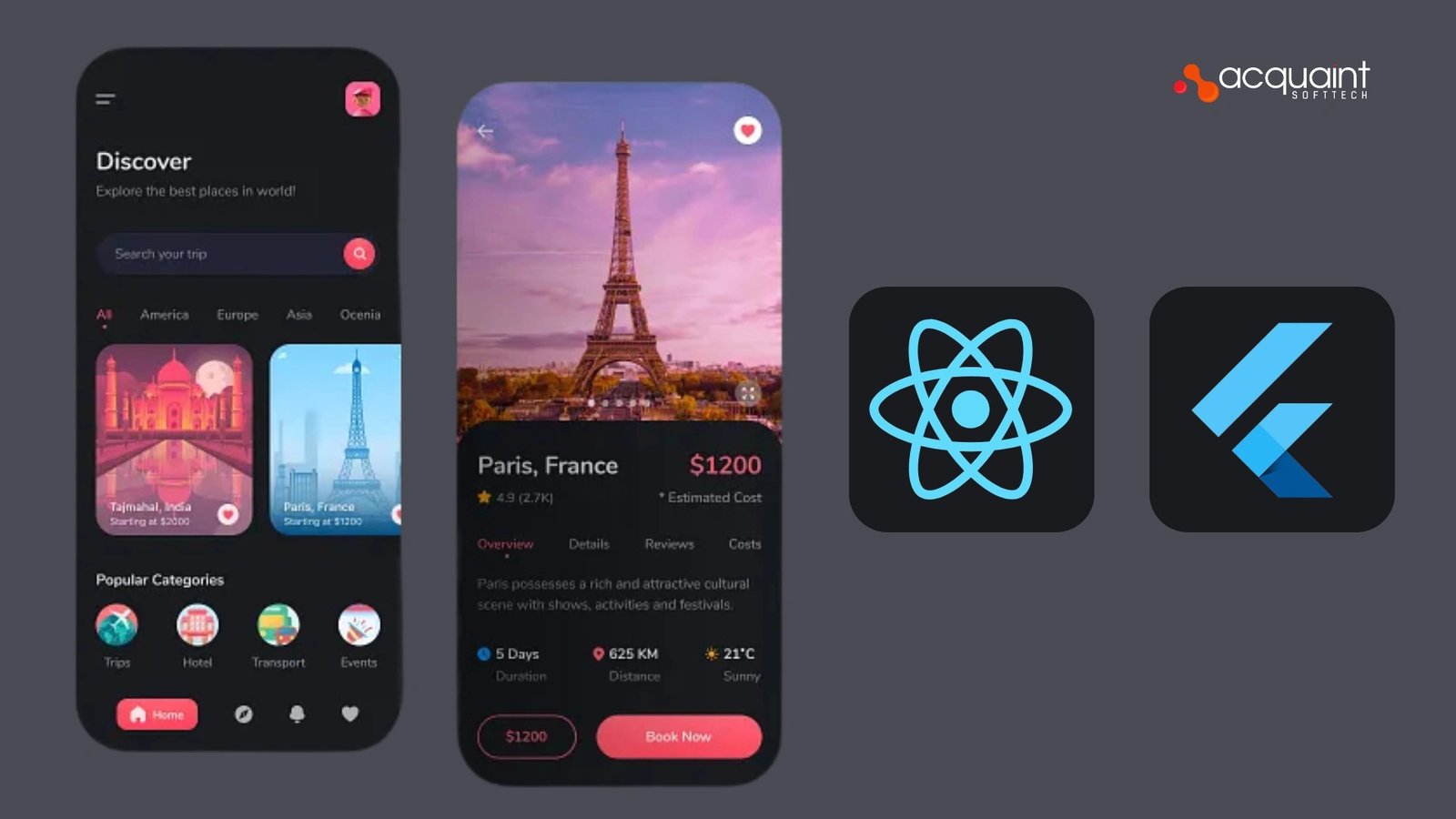
Choosing the wrong mobile framework for a travel app does not show up on day one; it shows up six months in, when maps stutter, offline mode drops a booking, or hiring stalls because the talent is scarce. React Native and Flutter are the two clear leaders in cross-platform development, and for a travel app that lives on maps, bookings, and patchy connectivity, the choice between them is worth getting right. The honest answer is that both are excellent, so the real question is which fits your app, your team, and your budget.
If you have already decided React Native is the right path, Acquaint Softtech’s React Native development services build travel and booking apps for clients across the USA, UK, Europe, UAE, and India.
As the Head of Business at Acquaint Softtech, I started as a developer and have spent more than ten years watching framework debates play out in real travel products. Both frameworks are mature and backed by tech giants: Meta builds React Native, and Google builds Flutter, and together they account for more than 80% of the cross-platform market, with Flutter near 46% and React Native near 35%, per the Stack Overflow Developer Survey. That balance is the point: this is a genuine trade-off, not a one-sided contest, and a fair comparison serves you better than a pitch.
This article compares React Native and Flutter for travel apps, focusing on performance, maps, and offline functionality. It also covers which framework to choose, implementation approach, best practices, costs, and real delivery insights backed by a verified case study. The wider build picture lives in our Complete Guide to Travel and Hospitality Software Development.
1. The Problem: Why the Framework Choice Makes or Breaks a Travel App
A travel app is one of the harder things to build well on mobile, because it has to do several demanding jobs at once: render maps, work offline, handle bookings and payments, and stay smooth on a five-year-old phone with one bar of signal. The framework you pick shapes how easily it does all of that, plus how fast and cheaply you can hire, ship, and maintain it.
Pick well, and the team moves quickly; pick badly, and you discover the limits halfway through, when changing course is expensive. Teams that want to move fast without a long hiring cycle often add mobile capacity through staff augmentation with framework specialists.
The stakes are real because both frameworks are genuinely capable, so the failure mode is rarely the framework itself. As reviewers often note, users do not care what framework an app uses; they care whether it loads fast, feels native, and does not stutter, and the best React Native apps and the best Flutter apps are both indistinguishable from native. The worst of either feel janky.
That means the decision is less about raw benchmarks and more about matching the framework to your app type, your team, and your roadmap, which is the kind of judgment software development outsourcing should bring to the table before any code is written.
Travel apps also rarely live alone. They sit beside a website, a booking engine, loyalty, and often AI-driven personalization, so the framework choice ripples into how easily the app shares code and talent with the rest of the stack. A team already invested in React for web, for example, gets real leverage from React Native. The wider guest-facing layer this connects to is covered in our guide on building an AI-powered guest experience platform. The framework is one decision inside a larger system, and it should be made with that system in view.
| Travel app demand | Why it is hard | Framework impact |
| Maps and location | Heavy, real-time UI | Rendering approach matters |
| Offline access | No signal in the field | Local storage and sync |
| Hiring and cost | Talent varies by stack | Pool size and rates differ |
2. React Native vs Flutter: The Core Difference
The core difference is how each framework draws the screen. React Native uses JavaScript or TypeScript and maps your code to real native UI components, so an app inherits the platform’s look and its OS-level updates. Flutter uses the Dart language and renders everything itself on a GPU canvas with its own engine, so an app looks pixel-identical on every device and version. This single distinction drives most of the trade-offs in performance, maps, and offline behavior that the rest of this guide compares. Choosing well from the start is core software product development judgment, not a detail to settle later.
That architectural split has practical consequences. React Native’s use of native components means a travel app feels at home on each platform and benefits from the enormous JavaScript ecosystem, while Flutter’s self-rendering gives total design control and very consistent visuals at the cost of a slightly larger app bundle. Neither is wrong; they are different philosophies, and the right one depends on whether you value native feel and talent availability or pixel-perfect custom design. Picking and staffing the right approach is what dedicated software development teams are built to do.
It also matters that both share with other platforms. Flutter reaches mobile, web, desktop, and embedded from one codebase, while React Native reaches web through React Native Web and reuses skills from React on the web.
For a travel brand that already runs a React-based site or booking flow, that shared foundation is a real advantage, and it connects to the booking architecture described in our guide on how to build an online travel agency architecture. The core difference, native components versus self-rendering, is the lens for everything that follows.
3. Performance Compared for Travel Apps
On raw performance, Flutter holds a real but narrowing edge, especially for animation-heavy and graphics-intensive screens. Because Flutter compiles to native machine code and talks directly to the GPU through its Impeller engine, it tends to deliver very smooth 60 to 120 FPS animations and slightly better CPU behavior during complex motion.
React Native has closed much of the gap in 2026 with its Hermes engine and New Architecture, and for the content, lists, forms, and booking flows that make up most of a travel app, the difference is rarely noticeable. Full-stack JavaScript teams that build these apps often hire MERN stack developers so the app and its services share one language.
For most travel apps, the honest takeaway is that both are fast enough, and execution matters more than the framework. A well-built React Native travel app feels native because it uses native components, while a poorly built app in either framework will stutter. Where an app is genuinely animation-heavy, think rich interactive storytelling or game-like experiences, Flutter’s rendering is the safer bet. The real-time, full-stack engineering behind a smooth app is what teams hire MEAN stack developers to deliver on a single JavaScript foundation.
App size and startup are part of performance too. Flutter bundles its rendering engine, so install sizes run roughly 4 to 8 MB larger than a comparable React Native app, which matters in markets where users watch their storage and data. Tuning startup time, memory, and bundle size on either framework is an engineering discipline, which is why a serious build will hire DevOps engineers to do profiling, builds, and release optimization.
| Performance | React Native | Flutter |
| Rendering | Native components | Own GPU engine |
| Heavy animations | Good, much improved | Slight edge, very smooth |
| Typical app size | Smaller | 4-8 MB larger |
| For most travel UI | Fast enough | Fast enough |
4. Maps Compared: Location, Routes, and Offline Tiles
Maps are central to travel apps, and both frameworks integrate the major mapping providers well, so neither blocks you from building a strong map experience. React Native typically uses native map components, which wrap the platform’s own Google or Apple maps, giving a familiar native feel and good performance for standard pins, routes, and location tracking.
Flutter draws its map UI through its own engine, which gives it an edge when you layer heavy custom overlays, animated markers, or constantly updating live positions on top of the map. The geospatial backend behind routes and location data is often built by teams who hire Python developers for the routing and location services.
For most travel apps, the map needs are well within both frameworks’ reach: show points of interest, plot a route, track the user, and cluster markers. The difference shows up at the extremes: an app with dense, animated, real-time map overlays, like live vehicle tracking across a whole city, leans toward Flutter’s smoother custom rendering, while a standard map-and-pins experience is equally clean in React Native. The structured backend that serves map and itinerary data reliably is what teams hire Django developers for, with a clean Python core behind the location APIs.
Offline maps are the harder part for travel, because travelers lose signal exactly when they need the map most. Both frameworks can cache map tiles and routes for offline use, but this is custom work in either case, planning which regions to download, storing tiles, and falling back gracefully when there is no connection. Getting that right takes experienced mobile engineers, which is why teams hire developers with real map and offline experience rather than treating it as an afterthought.
| Maps | React Native | Flutter |
| Map integration | Native map components | Drawn over the engine |
| Standard pins/routes | Clean, native feel | Clean, consistent |
| Heavy live overlays | Good | Slight edge |
| Offline tiles | Custom work | Custom work |
5. Offline Capability Compared: Booking and Itineraries Without Signal
Offline access is essential in travel apps, and both React Native and Flutter support it well. React Native uses tools like SQLite and WatermelonDB, while Flutter uses Hive and Drift. In both cases, data is stored locally so users can access key features offline and sync automatically when the internet is back. The backend sync APIs that make this reliable are commonly built by teams who hire Laravel developers for a clean, transaction-safe server-side.
The harder engineering is conflict-free sync, not storage. When a traveler edits an itinerary offline, and the server also changes, the app has to reconcile both without losing data or double-booking, and that logic is identical in difficulty whether you choose React Native or Flutter. This is where offline projects succeed or fail, and where ongoing software support and maintenance earns its keep as edge cases surface in the real world. The framework barely matters here; the sync design does.
One genuine difference is on-device intelligence. Flutter has an edge for offline, on-device machine learning through TensorFlow Lite, useful for features like offline translation or on-device image recognition, while React Native is especially strong when AI runs in the cloud, with mature SDKs for services like OpenAI and Azure. If your travel app needs heavy offline ML, that points toward Flutter; if it leans on cloud AI, React Native is very comfortable, and either way the underlying AI work is a natural fit for AI development services. Match the framework to where the intelligence lives.
| Offline | React Native | Flutter |
| Local storage | SQLite, MMKV, etc. | Hive, Drift, Isar |
| Sync patterns | Solid | Solid |
| On-device ML | Cloud-AI strength | On-device edge |
| Offline itineraries | Strong | Strong |
6. The Verdict: Which to Choose for a Travel App
For most travel apps, React Native is the preferred choice due to its native experience, larger developer pool, lower hiring costs, and easy integration with existing React web apps. Flutter is better for apps that need advanced animations, highly customized UI, on-device AI features, or support for diverse screen sizes and foldable devices. Deciding which profile your app fits is exactly the kind of virtual CTO services question worth getting right early.
The talent math is the quiet tie-breaker for many teams. JavaScript is known by roughly 67% of developers while Dart sits near 4%, and React or React Native job listings outnumber Flutter and Dart roles by a wide margin, so React Native teams are usually faster and cheaper to assemble, even though senior Flutter developers can command a scarcity premium.
React Native also powers apps serving billions of users, while Flutter powers major Google products and global brands, so both are proven at scale. Planning the team and roadmap around that reality is where teams hire project managers to keep delivery predictable.
| Choose React Native if | Choose Flutter if |
| You want a native platform feel | You want pixel-perfect custom UI |
| You share code with React web | You are animation- or graphics-heavy |
| You want the largest talent pool | You need heavy on-device ML or AR |
| It is booking and content heavy | You target foldables and many sizes |
7. Implementation, Technical Approach, and Mobile Best Practices
How to implement it for a travel app
Implementation for a travel app follows a clear sequence, and the first step is choosing the framework against your real requirements rather than the latest trend. The build then moves from a thin slice that proves the hardest parts, maps, offline, and a booking flow, to the full feature set, to device testing on real phones and networks, then a phased launch.
Front-loading the risky pieces, maps and offline sync, is what keeps a project from stalling late, which is why it starts with a discovery workshop that turns requirements into a concrete plan.
1. Choose the framework deliberately: match React Native or Flutter to your app type, team, and roadmap.
2. Prove the hard parts first: build a thin slice with maps, offline, and a booking flow before the rest.
3. Design offline and sync early: decide what works offline and how conflicts resolve, not as an afterthought.
4. Test on real devices and networks: validate on old phones, weak signal, and bright sunlight, not just simulators.
5. Launch in phases: ship to a small group, watch crash and performance metrics, then expand.
Technical approach and mobile best practices
Technically, a travel app should keep a thin, well-tested core and lean on proven native modules rather than reinventing maps or storage. The best practices that matter most are real-device testing, designing for offline from day one, keeping the app size and startup lean, and handling permissions and battery use for location carefully so the app does not drain a traveler’s phone. Teams that want a branded app without staffing a full in-house mobile team often use white label development services to ship faster.
Both frameworks evolve quickly, so keeping dependencies current is its own discipline. React Native has historically seen more library churn and breaking changes between versions, so disciplined version upgrade services keep a React Native app healthy over its life, while Flutter’s tighter, first-party ecosystem tends to be more stable but still needs regular updates. Either way, treat upgrades as routine maintenance rather than a once-a-year scramble, and the app stays fast and secure as the platforms change underneath it.
Read Also: Modern Advancements in Metal Bending Technology
8. Cost, Timeline, and Tech Stack
A focused travel app, core booking, maps, offline, and a clean UI on iOS and Android, typically starts in the low tens of thousands of dollars and takes a few months, while a full platform with rich maps, loyalty, payments, and AI features runs higher and longer. Framework choice has a modest cost effect: on a typical project, React Native can save a few thousand dollars in developer costs thanks to the larger, more affordable talent pool, though a well-scoped Flutter build is competitive.
The biggest cost levers are scope and integrations, not the framework name, so budget there honestly. A marketing site around the app can be handled separately, where teams hire WordPress developers rather than spending mobile engineering hours.
Location is the larger cost factor than framework. India-based engineering delivers the same quality at up to 40% lower cost than Western agencies, which matters most on a multi-month mobile build where senior time dominates the bill.
In-app booking and payment commerce is its own workstream, where teams hire WooCommerce developers for proven payment and order patterns. Spend the senior budget on maps, offline, and performance, the parts travelers actually feel.
| Layer | Recommended tech | Role |
| App (RN) | React Native + TS | iOS and Android UI |
| App (Flutter) | Flutter + Dart | iOS and Android UI |
| Backend | Laravel / Node | Bookings, APIs, sync |
| Maps and offline | Native maps + local DB | Field reliability |
| Build scope | India team | Western agency |
| Focused travel app | Lower cost, weeks | Higher cost |
| Full platform | Up to 40% saving | Baseline |
9. Real Case Study: Good2Know Real-World Performance
Good2Know is a phone-first product that turns a smartphone into a used-car expert, and Acquaint Softtech rebuilt its AI inspection engine and app to stay fast and accurate in messy real-world conditions.
This is a Clutch-verified engagement rated 5.0 across quality, schedule, and cost, and while Good2Know is a car-inspection product rather than a travel app, it proves the exact discipline this whole comparison turns on: a mobile experience that performs in the real world, not just in a demo. The wider track record behind work like this is set out in our overview of why Acquaint Softtech is the right travel and hospitality development partner.
Before, after, and the result
Before the work, the app struggled with the conditions real users create: photos taken in poorly lit parking areas, dust on the car, and odd angles produced ambiguous results that eroded trust. The team rebuilt the detection model and enhanced the preprocessing pipeline so the system could extract a car’s shape even in low light, added a confidence indicator so users understood why something was flagged, and tested relentlessly against real-world variation.
After the work, results were reliable in tough conditions, ambiguous-result complaints fell, and the platform felt stable and trustworthy, the same real-world resilience a travel app needs when a traveler opens it in a dim airport or a remote trailhead. The AI model engineering behind that is exactly what teams hire AI/ML engineers to deliver.
| Outcome | Before | After |
| Low-light input | Failed or ambiguous | Extracts shape reliably |
| User trust | Confusing results | Confidence indicator, clear |
| Testing | Assumptions | Real-world conditions |
| Stability | Complaints | Stable, trusted |
The lesson maps directly onto this comparison: the framework is a means, and the result is decided by engineering for the conditions real users face. Whether an app inspects cars or books trips, performance, reliability, and trust come from that discipline, which is what verified clients consistently highlight about working with the team.
10. FAQs
Is React Native or Flutter better for a travel app?
Both frameworks are excellent for travel apps. React Native is ideal for faster development and web code sharing, while Flutter suits highly customized UI and animations. The performance difference in 2026 is minimal.
How do I implement this for a travel app?
Choose the framework based on your business goals and app requirements. Build a prototype with maps, booking, and offline features first. Test on real devices before scaling and launching.
What is the technical approach and mobile best practices?
Use a lightweight architecture with proven map and storage libraries. Design offline functionality from the start and optimize app speed. Regular updates and testing help maintain performance.
Which framework is better for maps and offline?
Both support Google Maps, Apple Maps, and offline storage. Flutter performs slightly better for complex map animations. React Native provides a more native platform experience.
Does React Native still feel native in 2026?
Yes, React Native delivers a native-like experience on iOS and Android. Its New Architecture and Hermes engine improve speed and responsiveness. Most users cannot distinguish it from a native app.
How much does it cost to build a travel app?
| US Cost | UK Cost | Europe Cost |
| $20,000–$120,000+ | £16,000–£95,000+ | €18,000–€110,000+ |