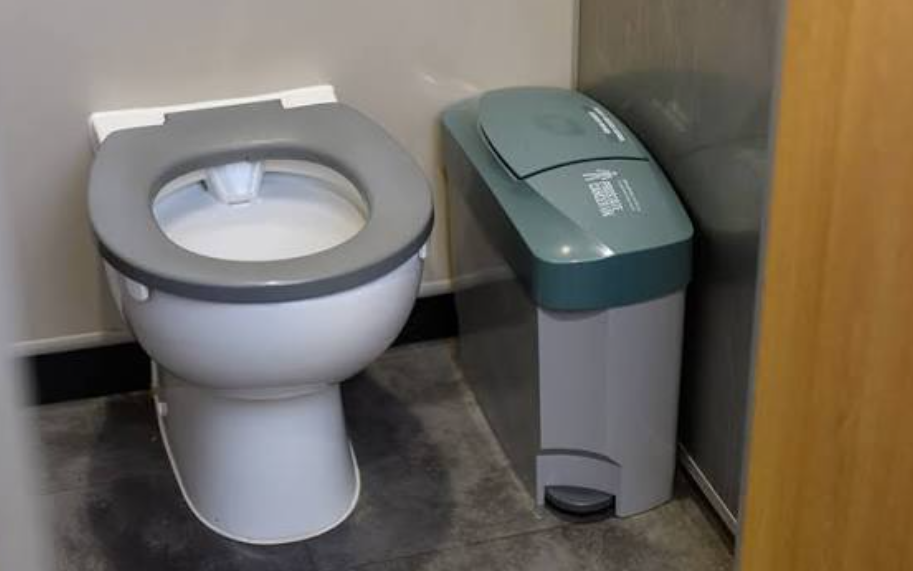
Everyone notices a washroom that isn’t clean, but almost no one thinks about why. More often than not, the culprit is something out of sight: the sanitary bin. Overflowing, poorly serviced or unhygienic disposal units quietly undermine the cleanest-looking washroom, and for facility managers they’re a constant, invisible headache. This guide walks through the real problem, the ways to tackle it, and the smartest fix available today.
The problem: what nobody talks about in the washroom
Picture the scene: a visitor walks into an office or shopping-centre washroom and finds a sanitary bin that’s full, jammed or unpleasant to use. In seconds, their impression of the whole building drops, and fair or not, that judgement sticks.
For the people responsible for the building, the frustrations are just as real:
- Overflowing bins between scheduled services. A fixed servicing schedule can’t tell the difference between a quiet washroom and a busy one, so some bins overflow while others are barely used.
- No visibility. Facility managers rarely know a bin is full until someone complains, by which point the damage to the user’s experience is already done.
- Hygiene and dignity concerns. Touching a bin lid to dispose of waste is exactly the kind of high-contact moment people want to avoid, and it’s a genuine hygiene risk.
- Wasted servicing visits. Technicians are sent on a calendar, not on need, emptying bins that aren’t full while others are left too long.
Hand hygiene and washroom cleanliness are closely linked: the U.S. Centers for Disease Control and Prevention points out that proper hygiene in shared facilities depends on reducing contact with contaminated surfaces and making clean, hygienic facilities easy to use. You can read its guidance on the CDC’s hand hygiene page. A washroom that forces people to touch a full, grubby bin works directly against that.
See also: Digital Tech Pack And Fast Production Line
The options: how businesses tackle sanitary waste
Most organisations manage sanitary disposal in one of three ways, each a step up from the last.
1. Do it in-house. Staff manage and empty bins themselves. It’s cheap on paper, but it’s unpleasant work, easy to neglect, and rarely done to a proper hygiene or compliance standard. Realistically, it doesn’t scale beyond a very small site.
2. A scheduled servicing contract. A hygiene provider visits on a fixed cycle (say, fortnightly) to empty and sanitise the units. This is a big improvement: it’s handled by professionals, consistently, and to standard. The weakness is the fixed schedule. Because every bin is treated the same, busy washrooms can overflow before the next visit while quiet ones are serviced needlessly.
3. Smart, monitored disposal. The newest approach puts sensors in the bins themselves. Each unit reports how full it is in real time, so servicing follows actual usage rather than a guess on a calendar. Busy washrooms get attended to more often, quiet ones less, and facility managers finally get visibility into what’s happening across their sites.
For any business beyond the smallest, the real choice is between the second and third options, and that comes down to whether you want to keep guessing, or know.
The solution: disposal that tells you when it’s full
This is where smart sanitary disposal earns its place. Instead of relying on a fixed schedule and hoping for the best, a sensor-equipped unit measures its own fill level and flags when it actually needs emptying.
Shmik Hygiene’s smartsan is built around exactly this idea. It’s a slim, touch-free disposal unit for sanitary and nappy waste that uses a calibrated laser sensor to track how full it is, then sends that data over its own dedicated 4G connection to a cloud dashboard, without touching the site’s Wi-Fi or IT network. That solves the problems above, directly:
- No more surprise overflows. Because fill levels are known in real time, busy washrooms are emptied before they overflow, not after a complaint.
- Touch-free, dignified disposal. A hand-presence sensor means users never touch the bin, cutting a real point of contact and germ transfer in the washroom.
- Servicing that follows demand. Technicians are booked when a bin genuinely needs it, so busy washrooms get more attention and quiet ones aren’t serviced for the sake of it.
- Real visibility for facility managers. Usage data across every washroom means no more guesswork, and a clear picture of what each site actually needs.
It suits the places these problems hit hardest: offices, shopping centres, hotels, schools, healthcare facilities (for appropriate non-clinical waste), industrial sites and any property manager juggling multiple washrooms. (One thing to note: it’s designed for sanitary and nappy waste, not a replacement for regulated clinical waste containers.)
The bottom line
The sanitary bin is the part of the washroom nobody wants to think about, which is exactly why it’s so often the weak link. Managing it well protects your building’s reputation, supports proper hygiene, and takes a recurring headache off facility managers’ plates. Moving from “empty it on a schedule and hope” to “empty it when the data says so” is the single biggest upgrade most businesses can make.
If overflowing bins, hygiene complaints or wasted servicing visits sound familiar, it’s worth seeing how smart, monitored disposal could change the way you run your washrooms, and whether a unit like smartsan is the right fit for your sites.